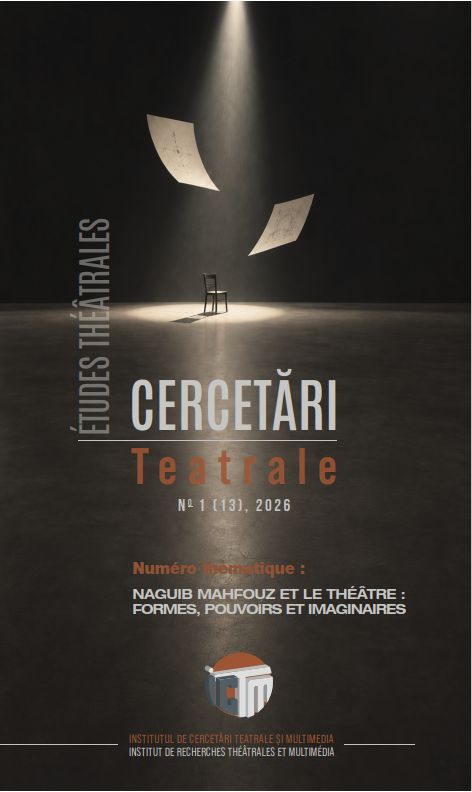
Du roman à la scène : Le diable fait la morale de Naguib Mahfouz, une allégorie théâtrale des paradoxes du monde arabe
DOI :
https://doi.org/10.46522/CT.2026.01.05Mots-clés :
religion, power, allegory, Arab theatre, Naguib Mahfouz;Résumé
From the Novel to the Stage: Naguib Mahfouz’s “The Devil Preaches Morals”, a Theatrical Allegory of the Paradoxes of the Arab World
This article reassesses the place of theatre in Naguib Mahfouz’s work through “The Devil Preaches Morals”, a hybrid text published in 1979. Drawing on the imaginary world of “The Thousand and One Nights” and on the symbolic setting of the “City of Brass”, the study shows how Mahfouz turns the marvellous into a critical device. The petrified city, the silenced people, the deified queen and the preaching devil form an allegory of post-Nasser Arab societies marked by authoritarianism, the manipulation of religion and the failure of modernity’s promises. The article therefore argues that Mahfouz the playwright extends his social realism by transposing it onto a symbolic stage where tradition, power and the future are put on trial. The play thus appears as a central and still relevant text on freedom, collective responsibility and the refusal of silence.
Références
"Al-Hakim, Tawfiq, 1933, Les Gens de la caverne (Ahl al-Kahf), Le Caire : Dar al-Hilal.
Bassiouney, Reem, 2014, Language and Identity in Modern Egypt, Edinburgh : Edinburgh University Press.
Eagleton, Terry, 2008, Literary Theory: An Introduction, Minneapolis: University of Minnesota Press.
El-Enany, Rasheed, 1993, Naguib Mahfouz: The Pursuit of Meaning (Arabic Thought and Culture), London: Routledge.
Esslin, Martin, 1987, The Field of Drama: How the Signs of Drama Create Meaning on Stage and Screen, London: Methuen.
Galland, Antoine, 2005 [1704], Les Mille et Une Nuits. Édition établie, présentée et annotée par Aboubakr Chraïbi, Paris : Garnier-Flammarion.
Hourani, Albert, 1991, A History of the Arab Peoples, Cambridge, Mass: Belknap Press of Harvard University Press.
Irwin, Robert, 1994, The Arabian Nights: A Companion, London: Allen Lane.
Khalidi, Rashid, 1997, Palestinian Identity: The Construction of Modern National Consciousness, New York: Columbia University Press.
Mahfouz, Naguib, 1985, Al-Liṣṣ wa al-Kilāb [Le Voleur et les Chiens], Khaled Osman (trad.), Paris : Sindbad.
Mahfouz, Naguib, 1979, Ash-Shayṭānu yaʿiẓu [Le diable fait la morale], Le Caire : Maktabat Misr / Dar Misr lil-Tibaʿa.
Mahfouz, Naguib, 1991, Awlād Ḥāratinā [Les Fils de la Médina], Jean-Patrick Guillaume (trad.), Paris : Sindbad.
Mahfouz, Naguib, 1993, Al-Thulāthiyya [La Trilogie du Caire : Impasse des deux palais – Le Palais du désir – Le Jardin du passé], Philippe Vigreux (trad.), Paris : J.-C. Lattès.
Molière, 1993 [1669], Tartuffe, Paris : Garnier-Flammarion.
Owen, Roger, 2000, State, Power and Politics in the Making of the Modern Middle East, London: Routledge.
Shafik, Viola, 2007, Arab Cinema: History and Cultural Identity, Cairo: American University in Cairo Press."
Téléchargements
Publiée
Comment citer
Numéro
Rubrique
Licence

Ce travail est disponible sous la licence Creative Commons Attribution 4.0 International .
Ce article est sous licence CC BY Creative Commons Attribution 4.0 International, ce qui permet toute utilisation, reproduction, distribution, auto-archivage et citation de l'œuvre, à condition que les auteurs soient crédités. Les données bibliographiques complètes de la revue doivent également être indiquées ; vous pouvez les trouver dans la section "Comment citer" de cette page. Si possible, veuillez également insérer un lien vers la publication originale. Le droit d’auteur des articles appartient aux auteurs.