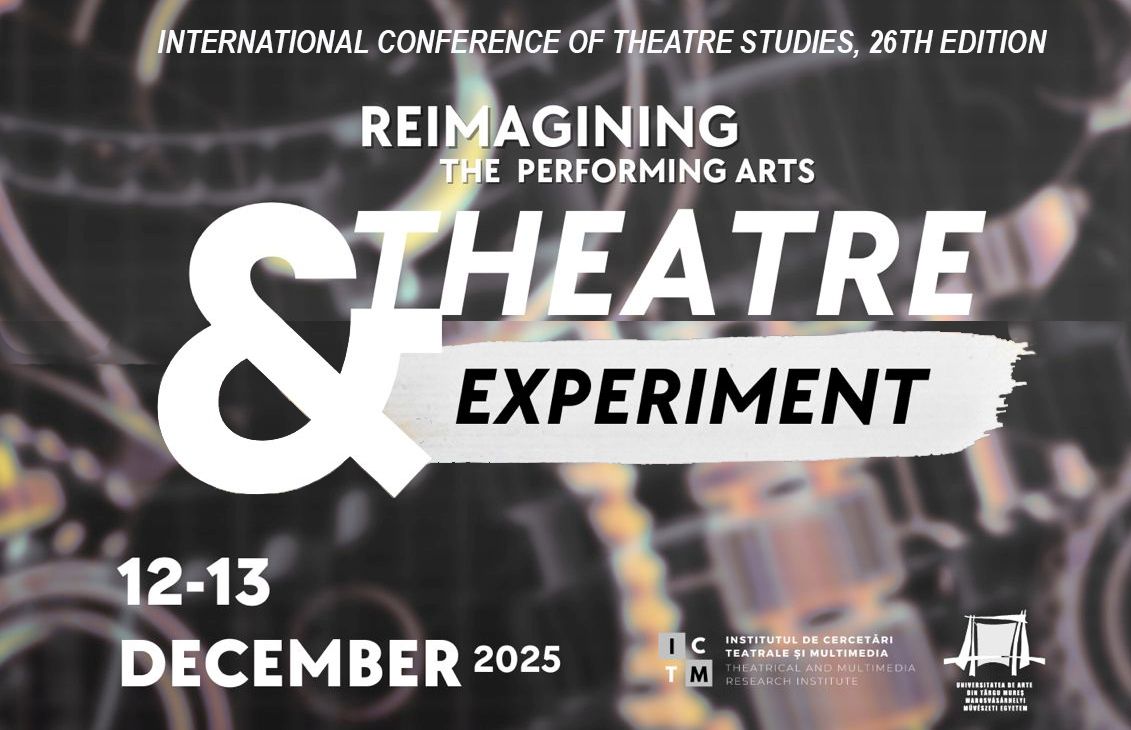
Theatre and Experiment. Reimagining the Performing Arts
INTERNATIONAL CONFERENCE OF THEATRE STUDIES - 26TH EDITION
UNIVERSITY OF ARTS OF TÂRGU MUREȘ, 12-13 DECEMBER 2025, TÂRGU MUREȘ, ROMANIA
“Today, a theatre that doesn’t view the spectator as a halfwit and refuses to sell its consumer products knows that it must be experimental, or not be at all.”
Patrice Pavis: Dictionary of the Theatre: Terms, Concepts and Analysis, translated by Christine Shantz, with a foreword by Marvin Carlson, University of Torronto Press, 1998, p. 135
Contents:
Conference Programme
Abstracts
Call for Contributinos
Download the programme in PDF format here.
December 12th 2025
Studium HUB (Bolyai street no. 15)
08.30—09.00 – Registration of participants
09.00-09.10 – Welcome speech, Professor Sorin-Ion Crișan, Rector University of Arts Târgu Mureș
09.15 –10.30: Session 1, chair Ildikó UNGVÁRI ZRÍNYI
09.15-09.30: Ildikó UNGVÁRI ZRÍNYI - The Sound, the Image and the Fury. The Theatrical Language of György Harag in the 1970s / A hang, a kép és az indulat. Harag színházi formanyelve a 70-es években
09.30-09.45: Tamás OLÁH – ‘It was a Time When you Could Only Say Yes and Applaud’ (György Harag: Sinners, 1974) / „Olyan korszak volt az, amikor csak igent lehetett mondani és tapsolni” (Harag György: Bűnösök, 1974)
09.45-10.00: Eszter SZABÓ-REZNEK – ‘His Path Leads Toward Directing’. György Harag’s Early Years at the Hungarian State Theatre of Cluj
10.00-10.15: Zsolt KARÁCSONYI – György Harag – Reception in Romanian / Harag György – román nyelvű recepció
10.15-10.30: Discussion
10.30-10.45: Coffee break
10.45 –12.15: Session 2, chair Sabin SABADOȘ
10.45-11.00: András HATHÁZI – Short Acting Experiment Interspersed with Some Intermezzos to Formulate a Theatrical Experiment/ Néhány intermezzoval tarkított színészi kísérlet a színházi kísérlet megfogalmazására
11.00-11.15: András BALÁSI – The Transformations of Theatrical Experiments/ A színházi kísérletek alakváltozásai
11.15-11.30: Adriana Ioana ISPAS – Reimagining the Art of Choreographic Performance: Inspiration and Innovation in the Style of Robert Wilson/ Reimaginarea artei spectacolului coregrafic: inspirație și inovație în stilul Robert Wilson- lumini, costume și machiaj
11.30-11.45: Patricia NEDELEA – Standup Comedy - a Form of Experimental Theatre
11.45-12.00: Paula DALEA – Laughing through Transition: Romanian Stand-Up Comedy as Urban Experimental Performance/Râsul în tranziție: Stand-up comedy-ul românesc ca performance urban experimental
12.00-12.15: Discussion
12.15-12.30: Coffee break
12.30 –14.00: Session 3, chair Raluca BLAGA
12.30-12.45: Cosmin MATEI – Aligning Pedagogy with Experimental Theatre Practice
12.45-13.00: Júlia Annamária SIMON – Experiments in Theatre and Education – The Example of the Performance Szörnyfogócska/ Kísérletek a színházban és a nevelésben – a Szörnyfogócska című előadás példáján keresztül
13.00-13.15: Virág Kincső VÖRÖS – Applied Theater as an Opportunity for Collective Creation/ Az alkalmazott színház mint a kollektív alkotás lehetősége.
13.15-13.30: Imola NAGY – The Beginnings of the Immersive Theatre/ Az immerzív színház kezdetei
13.30-13.45: Alexandru LASZLO - Theatre and Education: “Uno, nessuno e centomila” International Competition in Agrigento, Italy/ Teatru și Educație: Concursul Internațional “Uno, nessuno e centomila” din Agrigento, Italia
13.45-14.00: Discussion
14.00-15.30: Lunch break
12.30-14.15: Session 4, chair Cristian STAMATOIU
12.30-12.45: Diana NECHIT, Andrei ȘERBAN – Theatre and Experiment. Milo Rau and Tiago Rodrigues – Reimagining the Performing Arts between Document and Fiction / Le théâtre et l’expérimentation. Milo Rau et Tiago Rodrigues – réimaginer les arts du spectacle entre document et fiction
12.45-13.00: Cristian STAMATOIU – Dystopian Anthropo-cultural Vision of the Future Stage Experiments: Variations in the Interaction Between the Actor’s Body and an Entity Managed by the Artificial Intelligence/ Vision anthropo-culturelle dystopique sur les expérimentes scéniques à venir : variantes de l’interaction ente le corps de l’acteur et celui géré par l’Intelligence Artificielle
13.00-13.15: Amalia SZŰCS-BLĂNARU – Mysteries of the Macabre. György Ligeti and the theatrical experiment/Mysteries of the Macabre. György Ligeti et l’expérimentation théâtrale.
13.15-13.30: Nawel BELGHITH – 'When Theatrical Scenography Reinvents Space'/ « Quand la scénographie théâtrale réinvente l’espace »
13.30-13.45: Laïth IBRAHIM – French Theatre of the 18th Century as a Laboratory of Experimentation / Le théâtre français du XVIIIᵉ siècle comme laboratoire d’expérimentation
13.45 -14.00: Discussion
14.00-15.30: Lunch break
15.30 – 17.15: Session 5, chair Cristina OLAR
15.30-15.45: Cristina OLAR – Embodied Memory: The Impact of Choreographers Le Roy, Bel, and Charmatz on Experimental Performative Practices/Memoriea întrupată. Impactul coregrafilor Le Roy, Bel și Charmatz asupra practicilor performative experimentale
15.45-16.00: Márta-Adrienne ELEKES – Experimental Perspectives in Choral Theatre. The Encounter Between the Discantus Vocal Ensemble and the Musical World of Arvo Pärt / Kísérleti perspektívák a kórusszínházban. A Discantus Énekegyüttes és Arvo Pärt zenei világának találkozása
16.00-16.15: Gabor OLAJOS – Contemporary Stage Interpretations of Monteverdi’s L’Orfeo / Monteverdi L’Orfeo című operája kortárs színpadi megjelenítésekben
16.15-16.30: Alba Simina STANCIU – Opera Performance Stage Directing through Geometric Thinking of Space
16.30-16.45: Júlia GYÉRESI – Theatrical Experiment on the Football Field/ Színházi kísérlet a futballpályán
16.45-17.00: Andrei Mihail DOMINTE – The Stage Combat Lab Experiment or how stage fighting becomes a tool for artistic research in the development of the theatre actor
17.00-17.15: Discussion
18.00-19.00: Book launch: Bezsán Noémi - A hiány lendülete. Az erdélyi magyar táncszínházi hálózat
December 13th 2025
Studium HUB (Bolyai street no. 15)
09.00 – 10.45: Session 6, chair Raluca BLAGA
09.00-09.15:Mária ALBERT – Writing for the Stage as an Experiment
09.15-09.30: Magdolna JÁKFALVI – Avant-Garde Theatre as Experimentation
09.30-09.45: Árpád KÉKESI KUN – Experimental Theatre in the Hungarian Countryside During the 1970s
09.45-10.00: Beatrix KRICSFALUSI – Agonistic Derailments. On the Performativity of Milo Rau’s Theatrical Discourse Formats / Agonisztikus kisiklások. Milo Rau színházi diskurzusformátumainak performativitásáról
10.00-10.15: Ádám-Csaba BALOGH – Reenactment as Memory Laboratory: The Experimental Dramaturgy of Five Easy Pieces / Reenactment mint emlékezetlaboratórium: A Five Easy Pieces kísérleti dramaturgiája
10.15-10.30: Raluca BLAGA – Experiential Theater in the Stage Vision of Theatre Director Adi Iclenzan/ Teatrul experiențial în viziunea scenică a regizorului Adi Iclenzan
10.30 -10.45: Discussion
10.45-11.00: Coffee break
11.00-12.45: Session 7, chair Mária ALBERT
11.00-11.15: Yvette JANKÓ SZÉP – Arctic Hysteria in Three Acts. Kristian Smeds’ Nordic Trilogy
11.15-11.30: Dorka POROGI – ‘Man in Inhumanity’ – György Cserhelmi–Eszter Novák: Székfoglaló (Inaugural Lecture), 2025
11.30-11.45: Cristina-Genoveva MODREANU – Is Theatre Experiment Gendered?
11.45-12.00: Ardian KYCYKU – The Purposes and Costs of Experimentation in Playwriting (Case Study: The Albanian Author Shpëtim Gina, or the Genius Shadowed by Premature Death)/ Rosturile și costurile experimentului în dramaturgia balcanică (Studiu de caz: autorul albanez Shpëtim Gina sau geniul secondat de moartea prematură)
12.00-12.15: Tünde KOCSIS – Self-awareness-based Theatre Pedagogy – (How Can It Be) a Safe Experiment (?) / Önismereti színházpedagógia – (Hogyan lehet) egy biztonságos kísérlet (?)
12.15-12.30: Roland RÉZMŰVES – Empowering Communities Creatively through Heterarchical and Hierarchical Directorial Methods – Blood Wedding
12.30-12.45: Discussion
12.45-14.00: Lunch break
14.00-15.30: Session 8, chair Andrei-Călin ZAMFIRESCU
14.00-14.15: Laurențiu BLAGA – IN DREAM: Theatre as an Experiment of Perception at 3g HUB/ÎN VIS: Teatrul ca experiment al percepției la 3g HUB
14.15-14.30: Andrei-Călin ZAMFIRESCU – Go Down, Oedipus! The Postmodern Case for Soteriological Syncretism in Lee Breuer's The Gospel at Colonus/ Pogoară-te, Oedip! Pledoaria postmodernă pentru sincretism soteriologic din Bunavestire de la Colonos a lui Lee Breuer
14.30-14.45: Vasilica BĂLĂIȚĂ – Experimental Theatre as Critical Practice: From Theoretical Foundations to Live Creation in ‘Anatomia unei Femei’/ Teatrul experimental : De la fundamentul teoretic, la creația în direct în „Anatomia unei femei”
14.45-15.00: Veronka Örsike ASZTALOS – A New Way of Understanding Nora – The Liviu Rebreanu Company’s Play/A Nóra új értelmezése – a Liviu Rebreanu Társulat darabja
15.00-15.15: Csenge Orsolya VARGA – Reconfiguring Body and Space in Experimental Theatre: HODWORKS – As My Father Imagined It/ A test és a tér performatív újrarendezése a kísérleti színházban: HODWORKS – Ahogy azt apám elképzelte
15.15-15.30: Discussion
15.30-15.45: Coffee break
15.45-17.15: Session 9, chair Traian PENCIUC
15.45-16.00: Elena TUDORACHE – Theatre as Hyper-Medium: Reimagining Theatrical Experimentation in the Post-Postdramatic Era/Teatrul ca hiper-mediu: cum regândim experimentul teatral după postdramatic?
16.00-16.15: Amalia TĂNASE – Experiment as a Response to Weak Thought: Aesthetics of Fragmentation and Multiplicity in Contemporary Theatre
16.15-16.30: Anca Gabriela GHIMPU – The Animal Character in Performing Arts, between Tradition and Experiment: a Case Study
16.30-16.45: Nazim EREN – Is the Use of Artificial Intelligence in Experimental Theatre a New Horizon for Creativity or the Brink of Extinction?
16.45-17.00: Flavius RETEA – Theatre - The Anti-artificial Intelligence
17.00-17.15: Discussion
Writing for the Stage as an Experiment
Maria ALBERT, PhD
University of Arts, Târgu Mureș
Abstract: The paper explores various forms of creating the text of a performance. From ensemble-work and improvisation (Joan Littlewood and the Theatre Workshop, Peter Brook, Complicité, Pintér Béla Company) to the use of documentary sources, sometimes combined with improvisation, sometimes not (Milo Rau, Gianina Cărbunariu, Rimini Protokoll) or even the involvement of the audience (Peca Ștefan), new forms of creating the text have contributed to the revitalization of both the creative process and the theatrical experience. How does this effect the relationship between language, speech, writing and performative art? How does drama evolve in the context of our times? What are the expectations of theatre creators and spectators regarding “text”? What is the role text in theatre today? How can translation contribute to play-development? The search for the answers to these questions is framed by current ideas in linguistics, literary- and art-theory, and theatre science. Starting with a brief historical survey of the theories and practices related to dramatic text, the paper then analyzes several relevant performances and dramas.
Key words: drama, post-dramatic, documentary theatre, experiment, ensemble work
Bio: MARIA ALBERT, PhD (lecturer, University of Arts, Târgu-Mureș, Romania) has been teaching comparative literature, Romanian theatre, film analysis and translation techniques and has translated texts for the theatre. She has a doctoral degree in theatre from the I.L. Caragiale National University, București. She has contributed to theatre productions as a dramatic advisor. Publications include studies on contemporary theatre and dramatic writing and an English textbook for drama students (English Act, 2006). She participated in research projects with the themes: the history of Hungarian theatre in Romania, contemporary Hungarian theatre and otherness. She participated at several international drama-writing workshops and co-organizededitions of the International Playwriting Camp in Târgu-Mureș in cooperation with Lark Play Development Center, and with Peace Dale Global Arts, New York.
A new way of understanding Nora – the Liviu Rebreanu Company’s play / A Nóra új értelmezése – a Liviu Rebreanu Társulat darabja(I would like to hold my presentation in Hungarian.)
Veronka Örsike ASZTALOS, PhD
University of Arts Târgu–Mureș, Theatrical and Multimedia Research Institute
Abstract: Is Ibsen outdated today? It seems not. After all, in the international theatre sphere we can see some of his plays. New interpretations and adaptations usually seek to answer the question of which part of his oeuvre appeals to the audience of the second decade of the 21st century. On October 25, 2025, the Liviu Rebreanu Company of National Theatre Târgu-Mureș staged “Nora” by Sivan Ben Yishai, which was inspired by the work of the Norwegian author and directed by Bobi Pricop. In my presentation, I examine how this performance can be understood as an experiment, based on the director’s message found on the theatre’s website, Ibsen and Sivan Ben Yishai’s “Nora”, and last but not least, Pricop’s interpretation.
Key words: Nora, Henrik Ibsen, Sivan Ben Yishai, Bobi Pricop, National Theatre Târgu-Mureș
Bio: I work as a research assistant at Theatrical and Multimedia Research Institute of University of Arts Târgu–Mureș. I did my bachelor and master studies at Babeș-Bolyai University in Cluj-Napoca, Faculty of Letters, and after that I continued to study at the Doctoral School of Literary Studies of the University of Szeged. I defended my thesis in April 2025, in which I examined how Norwegian literature influenced Hungarian literature, theatre, and culture at the end of the 19th century, but also what we can learn about Hungarian literary modernism, press and media history and translation culture from this perspective.
The Transformations of Theatrical Experiments /A színházi kísérletek alakváltozásai
BALÁSI András, PhD
University of Arts, Târgu Mureș
Abstract: It is a reality and a commonplace of every age that the world is in a state of dizzying change; at this very moment we can also observe a continuously increasing information dumping (we deliberately do not name what kind of information we are referring to), the processing task and compulsion of which seems to exceed the existing capabilities of the human community. In this drift, phenomena and concepts are also changing, and an increasing number of questions arising in the wake of changes remain without an adequate answer, definition, or interpretation, although every question and problem raised in changing contexts also requires new and new definitions. Even seemingly simple things require new and new interpretations; we feel the compulsion of this to be important precisely in the rapid change: to ask again and again, to go around our problems to be discussed and debated. This is how we can ask the question: what do we call an experiment in theater; the question immediately triggers a barrage of nuances: what do we call it today and here, among what forms of implementation. In this context, the questions that constantly consolidate and continuously change theatre are raised even more sharply: what is the purpose of experiments in theatre? Why do we have to cross the boundaries again and again? Or: does its experimental nature exclude the general public to a certain extent? How do genres and techniques mix or the issue of the extremely current: marginality. We believe that it is impossible to go walk around everything, to “catch” – no matter how narrowly we apply – what such a series of phenomena could mean. However, if our investigations also address this, we must define, even if it is a fleeting attempt, what we are thinking of. We need to discuss how and why seemingly joyous forms and contents stiffen at the moment of their appearance, or vice versa. We must somehow catch for a moment (there is hardly any hope for more) – also by presenting a few concrete examples – that points, which is actually one of the unifying forces of all artistic research and creation. The more attempts at definition are made, the closer we come to phenomena in constant motion.
Key words: theater history, experimental theatre, performance analysis, characteristics of artistic research
Bio: BALÁSI András (b. 1967, Marosvásárhely/Târgu Mureș) PhD, theatrologist, poet, professor at the University of Arts Târgu Mureș, Faculty of Arts in Hungarian, Theatre Department. His main research fields are theory of drama and theater history. He has published three volumes of poems and three independent theoretical books, published numerous poems and studies in volumes and specialized journals, and is a member and leader of several scientific, artistic and development projects. He is a member of the external public body of the Hungarian Academy of Sciences, the Romanian Writers' Association, and the Romanian Theater Association.
"When theatrical scenography reinvents space" / « Quand la scénographie théâtrale réinvente l’espace »
Nawel BELGHITH, PhD
Université de Sousse/ Tunisie
Abstract: Initially created for the world of theatre, experimental theatrical scenography now represents a major artistic trend in the events sector. With the proliferation of new technologies and the emergence of a more demanding audience seeking singular and unique experiences, experimental theatre is increasingly striving to offer personalized, immersive experiences that allow spectators to live extraordinary moments. In this context, artists are multiplying strategies and innovating in terms of tools and means to offer spectators the opportunity to experience the work differently and to create new relationships with art. The objective of this presentation is to study the perspectives offered by new forms of scenographic expression to reinvent space and the relationship between the spectator and art. Using an analytical approach, we will examine the most innovative expressions in experimental theatrical scenography to better understand the relationship between art and space. To this end, we have chosen to divide this research into three equally important parts. First, we will analyze the Symbiosis Portland Art Museum performance to highlight the role of multisensory immersion in reinventing the scenographic experience and the relationship between the audience and the space. Second, we will analyze the "Scents of China" exhibition at the Cernuschi Museum, which took place in 2018. In this context, we will demonstrate how olfactory scenography creates a new form of immersion and forges a new relationship with space. Finally, we will analyze the 2022 "Gaudi, Architect of the Imaginary" exhibition at the Atelier des Lumières, which features a traveling scenography combining touch and sight.
Key words: space, immersive experience, scenography, meaning, art, theatre
Bio: Dr. Nawel Belghith, lecturer and researcher at the Higher Institute of Fine Arts/University of Sousse, Tunisia. Holds a Master's degree in Aesthetics and Visual Arts Practices. Doctor of Design theories and Practices. PhD thesis entitled "The Sensory in Contemporary Urban Scenography: Constraints and Perspectives. The Case of the Festival of Lights in Lyon."
Experiential theater in the stage vision of theatre director Adi Iclenzan/ Teatrul experiențial în viziunea scenică a regizorului Adi Iclenzan
Raluca BLAGA PhD
University of Arts, Târgu Mureș
Abstract: This paper responds to the invitation extended by the organizers of the International Conference on Theater Studies and aims to engage in dialogue with this year's theme by bringing to the fore the personality of theatre director Adi Iclenzan, an artist from the local theater scene who has embarked on the risky and revelatory path of theatrical experimentation. Starting from the original meaning of the term experimentum, but also from observations on theater and experimentation theorized by James Roose-Evans and Alexandra Titu, this article will highlight the distinct meanings and directions of experimentation and experimental attitude as they appear in three of the performances directed by Iclenzan in the 2022/2023 season: Ciclopul/The Cyclope, produced by 3gHUB; Jocul ielelor/The Game of the Fairies, produced by the ‘Liviu Rebreanu’ Company - National Theater Tirgu Mures, and Tinerețe fără bătrânețe și viață fără de moarte/ Youth without old age and life without death, produced by the ‘Fani Tardini’ Dramatic Theater in Galati. From a methodological point of view, the research will use both the tools of performance analysis, as well as information I gathered from eight semi-structured interviews conducted specifically for this paper with some of the actors, playwrights, opera(c)tors, and video designers involved in the aforementioned creative projects.
Key words: experimental attitude; unknown; new modes of communication; experiential theatre; Adi Iclenzan.
Bio: Raluca BLAGA read Theatre Studies at the University of Arts Tirgu Mures and Mathematics – Informatics at Petru Maior University Tirgu‐Mures between 2002 and 2007. Between 2006 and 2008, she was a part of Theatre 74’s team – an independent, alternative theatre. In 2012 she defended her doctoral thesis entitled Adaptations of Tragic in Contemporary Dramaturgy and joined the teaching staff of the University of Arts from Tirgu‐Mures. Her current research interests concern the relationship between performance and audience. Raluca Blaga is also the author of un regizor: Theodor-Cristian Popescu, UArtPress, Presa Universitară Clujeană, 2025 and (Su)poziţii teatrale sau ancore împotriva nostalgiei confortului, Eikon Publishing, 2018.
Laughing through Transition: Romanian Stand-Up Comedy as Urban Experimental Performance / Râsul în tranziție: Stand-up comedy-ul românesc ca performance urban experimental
Paula DALEA
National Theatre Aureliu Manea Turda
Abstract: This paper examines Romanian stand-up comedy as an emerging form of experimental theatre, addressing the central questions proposed by the conference: the role, purpose, and mechanisms of experimentation within the contemporary performing arts. Although its roots in Romania can be traced to the late 1990s, when the first comedy nights, bar circuits, and informal open-mic gatherings began to appear, the genre has grown into one of the most influential urban performance practices of the last two decades. Its development reflects the transformations of Romanian society after 1989: rapid urbanisation, the emergence of new leisure cultures, digital acceleration, and a public increasingly shaped by migration, precarity, inflation, bureaucratic overload, and political exhaustion. What makes stand-up relevant to discussions about experimental theatre is not its format, but the performative mechanisms through which it generates meaning. Stand-up constructs a carefully modulated relationship between performer and audience, one based on presence, timing, narrative construction and the constant recalibration of tone and risk. The stage becomes a negotiated space: the persona appears spontaneous while crafted through dramaturgical text; the microphone, lighting, and minimal setting act as functional scenographic elements; and the audience’s reactions shape rhythm, structure, and thematic direction. Rather than functioning as passive viewers, spectators become co-authors of the event, jointly producing tension, release, and the shared fiction of authenticity. The paper situates Romanian stand-up within a broader cultural history, comparing it to the American model while outlining key differences: the absence of a long institutional tradition, the impact of post-socialist transitions, and its strong anchoring in urban life. Romanian stand-up emerged in cafés, bars, and alternative venues—spaces of informal, accessible experimentation that counter the perception of experimental theatre as elitist. Instead, it demonstrates how experimentation can thrive as a community-oriented practice shaped by the lived experiences of young urban audiences. Ultimately, this paper positions Romanian stand-up comedy as a significant and understudied site of theatrical experimentation—one that reshapes spectatorship, expands the vocabulary of performance, and reflects the social and cultural dynamics of contemporary Romanian urban life.
Key words: stand-up comedy; live performance; post-socialist transition; urban culture; informal cultural spaces
Bio: Paula Dalea is an emerging theatre critic whose work brings together performance studies, digital archiving, and the cultural dynamics of post-industrial Romanian cities. She is a graduate of the Theatre Studies (Theatrology) Department of the University of Arts of Târgu Mureș and holds a master’s degree in Cultural Management and Entrepreneurship from the “Lucian Blaga” University of Sibiu. She is currently the artistic secretary of the National Theatre “Aureliu Manea” Turda, where she is responsible for the institution’s archive, artistic documentation, research, communication, and the coordination of editorial and curatorial content for GraFITT, the theatre’s in-house publication. In 2025, she joined TNAMT Digital, the theatre’s multi-year platform dedicated to preserving, digitizing, and reimagining archival materials through new media. Within the Mind the Gap. Echoes from the Archive project, her contribution focuses on historical research, documentation, and contextual analysis of archival materials, supporting the curatorial team in reconnecting contemporary audiences with the theatre’s documentary heritage.
The Stage Combat Lab Experiment or how stage fighting becomes a tool for artistic research in the development of the theatre actor.
Andrei Mihail DOMINTE PhD
University of Arts, Târgu Mureș
Abstract: In this article, I aim to investigate the art of stage combat as both experiment and experience in shaping an enhanced physicality for the theatre actor. This involves a thorough analysis of artistic fencing techniques with weapons, as well as an exploration of the fundamentals of learning, choreographing, and performing unarmed combat. From the initial stage of familiarization to the actual execution of armed and unarmed fights, we will go through the entire working process, which I have termed the “combat lab” centered on the actor as both performer and analyst of their own body. In this approach, I will act as observer, witness, choreographer, and trainer, highlighting how this entire field of simulated-violence design can become a tool for active research and for discovering new working methods that foster the development of technical skills, advanced bodily awareness, expressiveness, instinctive action, and a deeper perception of scenic conflict and its direction toward the working partner or partners. As a preliminary step, we will examine how experimentation interacts with the art of stage combat from both technical and aesthetic perspectives, through choreographed risk and a specific training method, thereby confirming the function of experiment inherent in this physical conflict art.
Key words: Experiment, Experience, Stage combat, Artistic fencing, Actor’s physicality.
Bio: Andrei Mihail Dominte is an actor, professor, stage fencing coach and an unarmed combat choreographer. He is a first-year PhD candidate at the University of Arts in Târgu Mureș, in the field of Theatre and Performing Arts, where he studies stage combat techniques and how they shape a specific type of training for actors, developing his own working method.
Experimental Perspectives in Choral Theatre. The Encounter Between the Discantus Vocal Ensemble and the Musical World of Arvo Pärt / Kísérleti perspektívák a kórusszínházban. A Discantus Énekegyüttes és Arvo Pärt zenei világának találkozása
Márta-Adrienne ELEKES PhD
University of Arts, Târgu Mureș
Abstract: In recent decades, the exploration of intersections between experimental theatre and vocal music has become increasingly prominent in artistic practices that regard music not as an accompanying element, but as a central agent of theatrical meaning-making. The work of the "Discantus" Vocal Ensemble exemplifies this tendency: originating from the Renaissance and early Baroque repertoire, the ensemble has progressively turned toward stage productions in which the choir, as a sounding and embodied collective, fulfils complex theatrical functions. A key milestone in this process is Prophecies and Gospel, a choral-theatrical creation dedicated to the ninety-year-old Arvo Pärt. The production places the composer’s sacred works in dialogue with compositions from various historical periods written on prophetic Old Testament texts. Its musical structure and its restrained, contemplative stage language employ the tools of choral theatre within a spiritually charged performative space. The central question of this inquiry is how Arvo Pärt’s purist, essentialist musical thinking can be reconciled with the visual and performative dimensions of theatrical presentation. Is it possible to articulate a minimalist scenic language that does not impose itself upon the music, but instead follows the acoustic and temporal logic of the tintinnabuli aesthetic, becoming its organic extension? The choral-theatrical reading of Prophecies and Gospel may thus be regarded as a case study that enriches the concept of experimental theatre through a music-centered lens and contributes to its reconsideration within contemporary performing arts discourse.
Key words: choral theatre; Arvo Pärt; experimental performance; minimalism; vocal embodiment
Bio: Márta-Adrienne Elekes completed her university studies at the Bucharest Music Academy in the musicology and musical interpretation department (piano section), followed by an additional year of postgraduate study in music science. She defended her Ph.D. at the National University of Music Bucharest in 2001 with the dissertation Polimodal Chromatic Principles in Lendvai Ernő’s Analytical Theory Regarding Romantic Music. Her habilitation thesis, Musical Art as Tradition and Contemporary Existence – an Ever-Present Field in Unraveling Meanings and Exploring the Perpetual Dynamics of Life, presented at the Gheorghe Dima National Music Academy in Cluj-Napoca in 2023, reflects the thematic coherence of her academic career. Since 1995, she has been a teacher at the Târgu Mureș Music High School, and since 1999 she has collaborated as music secretary with the Târgu Mureș State Philharmonic Orchestra. In 2004 she joined the Music Department of the University of Arts in Târgu Mureș, where she currently serves as department head and full professor. She has published several books, including Music Turned Into Words – Contribution to the Music Chronicle of Târgu Mureș; The Secrets of the Romantic Composition in the Light of Lendvai Ernő’s Analytical Theory; Between Glass Stains – Anniversary Book Szabó Csaba; Past and Present. Studies on Music; and At the Confluence of the Organization of Musical Life and the Cultivation of Talent from a Musicologist’s Perspective.
The Animal Character in Performing Arts, between Tradition and Experiment: a Case Study
Anca Gabriela GHIMPU PhD
Babeș-Bolyai University, University of Arts Târgu Mureș
Abstract: The use of animal characters in literature and performing arts goes back to ancient times. From the oral tradition of fairy tales, folklore stories, legends or myths up to written texts that made a career in classical literature -fables, plays, stories, novels etc.- people have always used animal characters to prove human points. Now, why is that? Is it only to make moral points, as per the famous fables or just to make fun of the flaws pertaining to the human character (as in Aristophan's entertaining and everlasting plays)? Or is it just a “Darwinist” self-reflection by which humans like to contemplate their humanity versus their supposedly left-behind-animality? Either way, a philosophical answer is needed, given the omnipresence of animals in art as a special kind of metaphor or symbolism. In theatrical shows, for example, we often encounter characters in animal form, either coming as such from the original text, or as new characters turned into animals with human features or into humans with animal features. One obvious (and maybe easier?) answer is that artists oftentimes aim to show monstrosity on stage, a feature that brings humans closer to animality (think of Caliban, for example). Animal traits are used to express hybris and monstrosity as an artistic way to push the human reflection into the darker areas of the human soul. Starting from these questions we aim at analyzing how animal-characters can add a new layer of expressivity and meaning (if any!) to the ongoing experiment called “contemporary theater”. As an independent actress working on creating her own show - in this case a one-woman show that employs several animal characters - these questions have crossed my mind since the first phase of my project - deciding which text to use for my show. Given that I stumbled upon a Chuck Palahniuk short story with only animals as characters, it immediately struck me with its stage potential. So, I had to rewrite it and freely adapt it for the stage. So, this was the context, and these are the questions by which I hope to open an interesting discussion on the presence and role of animals in live theater - as a new type of experimental characters. Given the immense human struggle that has originally inspired the birth of theater as a form of art, why use animals as theatrical characters?
Key words: animal character, animality, anthropomorphization, monstruosity, fable
Bio: Independent artist, improvisation trainer and academic researcher based in Cluj Napoca, Romania. After completing my studies in Philosophy and specializing in Culture and Communication with a Master’s degree from UBB university, I took my PhD in the History of Philosophy in 2011 from UBB as well. After several years of academic and corporate work, I have resumed my studies to become an actress, obtaining a Bachelor's and a Master’s degree in Acting in 2024 from UAT Târgu Mureș. My area of interests are: philosophy and the history of ideas, acting, improvisation, history of art, contemporary culture and communication.
Theatrical Experiment on the Football Field/ Színházi kísérlet a futballpályán
Júlia GYÉRESI PhD
University of Arts, Târgu Mureș
Abstract: Every year, I hold a drama camp for children aged 9 to 12 at the invitation of the Őrző Association in Petrilaca de Mureș. This year, our shared creative journey took place from June 30 to July 4, 2025. Together with the organizers, Annamária Bíró and Zoltán Bíró, we announced the camp under the title Stage by Stage, with the theme: developing body awareness through play. My goal was to help participants become more conscious of their bodies - to cultivate harmony and a sense of self-forgetfulness through exploring movement, sensation and bodily awareness. This process touched on self-image and body image, perception and attention, coordination, mental health, and emotional regulation. As we got to know the children, we collaboratively created a theatrical experiment with three groups. Each group presented an outdoor performance consisting of three scenes on a football field, while a large audience watched from the hillside.
Key words: experiment, acting camp, theater in nature, interaction, community experience
Bio: Júlia Gyéresi is a university lecturer at the Târgu Mureș University of the Arts, where she teaches speech techniques and artistic speaking. During the summer, she leads theatre camps that focus on self-awareness, cultivating effective communication, and fostering a sense of community. She graduated as an actress from the Târgu Mureș University of the Arts, and her doctoral dissertation was based on her own teaching methodology, titled The Practical Use of Half-Bound-Form Textual Improvisation (HBFTI) in Speech Training. Her guiding belief is that speech is not merely a technique, but an inner journey of self-discovery.
Short acting experiment interspersed with some intermezzos to formulate a theatrical experiment / Néhány intermezzoval tarkított színészi kísérlet a színházi kísérlet megfogalmazására
András HATHÁZI PhD .habil.DLA
Babeș-Bolyai University, Faculty of Theatre and Film, Hungarian Theatre Department
Abstract: Whenever I participate in various theatre-related events (competitive exams, doctoral discussions, conferences, etc.), in most cases I encounter the problem that words mean different things to different people. Although it seems that we understand the same thing when we talk about presence, authenticity, or energy (to mention a few of the most overused concepts), it is quite clear that there are as many ways of talking as there are people. And in the end, the whole communication attempt becomes like the problem of homousion or homoiusion. Even if we try to clarify what we mean by the words we use before making any statements. Well, this paper attempts to understand the theme of this conference. It seeks nothing more than to find out how the relationship between theatre and experimentation can be interpreted, how the performing arts can be rethought. To this end, it draws on the Hungarian Explanatory Dictionary, available in the Arcanum database on the Internet. And at the very end it has some questions…
Key words: Theatre, Experimentation, Conference, Understanding, Euphemism
Bio: András HATHÁZI, actor, director, writer, university professor at the Faculty of Theatre and Film of the "Babeș-Bolyai" University, where he deals with the actor's art and theatre improvisation. He obtained his doctorate in 2003 from the University of Theatre and Film Arts in Budapest in the field of improvisation and development of the personality. His work consists of more than 100 theatre and film roles, dozens of theatre, puppet theatre and film directions, articles on the actor's art, plays and screenplays. His individual books include Daniló (2004), A hetérák tudománya (2006), Improvizáció és személyiségfejlesztés (2007), A semmitmondó szöveg (2023), and a translation of David Zinder's Body-Voice-Imagination (Test-Hang-Képzelet, 2009). His work has been honoured with more than 50 individual and joint awards at national and international level. 4Prof.
French Theatre of the 18th Century as a Laboratory of Experimentation / Le théâtre français du XVIIIᵉ siècle comme laboratoire d’expérimentation
Laïth IBRAHIM PhD
Mutah University, Jordan
Abstract: The Enlightenment era marks a profound reconfiguration of theatre as a site of intellectual and aesthetic experimentation. Situated between Enlightenment philosophy and theatrical poetics, the stage becomes a laboratory for testing ideas and hypotheses about human nature, social relations, and the force of passions. From Marivaux to Beaumarchais via Diderot, theatre abandons the constraints of classical verisimilitude to reinvent itself as a place of observation, analysis, and social critique. In this paper, we propose to reread the theatre of the Enlightenment as a form of “thought experiment,” in the sense that dramatists use it to devise experimental devices to probe a reality that is already poorly known: Marivaux, in La Dispute(1744), questions the genesis of sentiments and the dialectic of desire; Diderot, in Le Fils naturel (1757) and Le Père de famille (1758), tests bourgeois morality and the educational function of the stage; Beaumarchais, for his part, experiments in The Marriage of Figaro (1778) with the social and political tensions of a society in transition. Thus, rather than reducing 18th-century French theatre to a mere reflection of the century’s ideas, our aim is to reread it in order to explicate the sensitive, dramatic, and reflexive enactment of those ideas. By intertwining play, fiction, and reflection, Enlightenment theatre anticipates contemporary theatre and its experimental dimensions: it constitutes a laboratory where new forms of thinking and new ideas are invented.
Key words: Enlightenment theatre, experimentation, Marivaux, Diderot, Beaumarchais, thought experiment
Bio: Laïth IBRAHIM is an Associate Professor of French Literature at Mutah University in Jordan and Assistant to the Dean of the Decanate of Scientific Research. He holds a bachelor’s degree in European Languages from Mutah University, a master’s in French literature from Sidi Mohamed Ben Abdellah University (Morocco), a Master’s in Linguistic Sciences from Cergy-Pontoise University (France), and a Ph.D. in French Literature and Civilization from Sorbonne University. A member of several international scientific committees, he has served on the jury for the Goncourt Prize of the Orient since 2019. His research focuses on the role of fiction in various fields, including anthropology, philosophy, argumentation, sociology, and politics, particularly in relation to identity and utopian thought. He is the author of Naissance de l’individu et émergence du roman de formation : la contribution des années 1730 en France (L’Harmattan, 2020) and Utopie et théâtre : d’une idée évasive à la concrétisation effective dans L’Île des esclaves, L’Île de la Raison et La Colonie de Marivaux (Éditions Universités Européennes, 2013).
Reimagining the Art of Choreographic Performance: Inspiration and Innovation in the Style of Robert Wilson
Adriana Ioana ISPAS PhD
Lucian Blaga University, Sibiu
Abstract: In the last decade, choreography has evolved beyond traditional movements and techniques, exploring new forms of expression that include complex visual elements, interactivity, and the theatrical atmosphere specific to the art of total performance. An important direction in this re-imagining is the influence of director and artist Robert Wilson, known for his distinctive visual style, in which choreography, lighting, costumes, and makeup are interconnected to create a transcendent and profound atmosphere. His performances, although closely related to experimental theater, have had a significant impact on contemporary choreography, inviting an interdisciplinary approach to performance art. The paper examines how contemporary artists borrow from Robert Wilson’s aesthetic and technical language to create innovative performances. Wilson transformed choreography from a simple art of movement into a complex visual medium in which time, space, and the viewer’s perception are manipulated with the help of light, music, elaborate costumes, and dramatic makeup. In Wilson’s vision, the body is not just an instrument of movement, but an object of performance, being enveloped in visual elements that transform it into a “vehicle” of an emotional and visual story. The study pursues the need to reinvent choreography in the context of postmodern theater, emphasizing the importance of integrating visual elements. Robert Wilson urges innovative accents precisely to reach deep into the self of the performance and the performer. Today, these searches for choreography are understandable considering the bodily impact on the young generation that is increasingly moving away from the sphere of classical dance.
Key words: contemporary choreography, Robert Wilson, visual theatre, performance art, light and scenography, costume and make-up, aesthetics.
Bio: Adriana Ispas is a choreographer and ballet-teacher for the Lucian Blaga University Sibiu since 2022, and doctor from 2024. She has collaborated with some of the most prestigious dancers and teachers în the country and from abroad (world champions: Mirona Gliga- Romania, Catia Vanone- Italy, Andreea Suciu- Romania, Karina Rubio- Spain, Ramona Palade from Sibiu Ballet Threatre, etc), having important roles în world vup dance competions and shows of ballroom dance and ballet arts. She has participated în numerous național and internațional dance festivals în Bulgaria, Greece, Russia, Germany, Italy, like dancer and teacher, and guide the young dancers from her town for 16 years and now she guide the students. In 2025 ,november she launched the book Emotion in the Scenic Universe.
Arctic Hysteria in Three Acts. Kristian Smeds’ Nordic Trilogy
Yvette Jankó Szép, PhD
Babeș–Bolyai University, Cluj
Abstract: Kristian Smeds' arctic trilogy, loosely based on the life and art of three legendary northern Finnish artists, Kalervo Palsa, Timo K. Mukka and Reidar Särestöniemi, has recently come to its conclusion. As a resident artist of the Finnish National Theatre, then as a freelancer, Smeds had the opportunity to experiment quite freely with theatrical styles, genres, the adaptation of non-dramatic texts, visual artworks and biographic material in order to capture the extreme nordicity associated with this 20th century triad of celebrated and/or self-destructive artists, and create a series of unique theatre events that also represent different stages of Smeds' self-exploration as an artist of the North.
Key words: exprrimental theatre, auteur, nordicity, arctic hysteria
Bio: Jankó Szép Yvette is an assistant professor at the Faculty of Letters of the Babeş–Bolyai University in Cluj, teaching courses on translation, Finnish literature, theatre and drama. Her studies included English and Finnish language and literature, theatre studies and American studies. Her main research interests are in Finnish theatre and drama, as well as the translation of dramatic texts. Main publications in the field of drama translation include: Mika Myllyaho: Káosz, Színház, X. 2009; Leea Klemola: Majd ha fagy, Magyar Lettre Internationale, 90. 2013; Anna Paavilainen: Play Rape, Játéktér, 2017/autumn.
Experimental Theatre in the Hungarian Countryside During the 1970s
Árpád KÉKESI KUN, PhD.habil.
University of Arts, Târgu Mureș
Abstract: While at the turn of the 1960s and 1970s, the traditions of the avant-garde could only prevail in amateur (or alternative) theatre in Hungary, by the second half of the 1970s, the conception of theatre as an experiment began to permeate some of the performances of official theatre as well. However, this only affected the provincial theatres, and the theatres in Budapest did not show any movement from the canon. My lecture analyses two such experiments: the 1977 première of Ubu Roi in Pécs and the 1979 première of Ubu enchaîné in Szolnok. Both are linked to the name of István Paál: he is the only Hungarian director who staged two Ubu dramas in two places. I am looking for an answer to the question of what political overtones the two productions got saturated with in the theatre culture of state socialism, and how they operated the dramaturgical procedures of the classical avant-garde.
Key words: Alfred Jarry, Ubu Roi, Ubu enchaîné, state-socialism, Hungary, 1970s, provincial theatres
Bio: Árpád Kékesi Kun is a Professor at the Doctoral School of the University of Arts, Târgu Mureş and at the Department of Theatre Studies of Károli Gáspár University, Budapest. He was the chairman of the Committee of Theatre and Film Studies at the Hungarian Academy of Sciences for twelve years and has been the editor of Theatron since 1998. His research work and publications focus on 20th century and contemporary trends of director’s theatre, as well as the past and present of music theatre (mostly staging operas). He is the author and editor of fifteen books and more than a hundred essays on various aspects of the performing arts. His most recent publications include the English-language monograph, Ambiguous Topicality. A Philther of State-Socialist Hungarian Theatre (L’Harmattan, 2021).
Self-awareness-based Theatre Pedagogy – (How Can It Be) a Safe Experiment (?) / Önismereti színházpedagógia – (Hogyan lehet) egy biztonságos kísérlet (?)
Tünde KOCSIS
Babeș Bolyai University, Faculty of Theatre and Film, Cluj-Napoca
Abstract: Most societies around the world are beginning to discover the effectiveness of arts education, including theatre education and theatre pedagogy. This interdisciplinary field is a very attractive and open experimental area, even for people with little or no training, experience, or knowledge in the field. As reported in a 2010 DICE study, despite their many positive effects, theater education practices can also have negative effects due to the powerful influence of theatrical elements and tools. "Dangerous" experiments are particularly common in the field of theater education that promotes self-awareness. In my presentation, I draw conclusions from ten years of experience with the self-awareness theatre pedagogy program Eszik vagy isszák? (Shall We Eat or Drink?) of the Hungarian Theatre of Cluj. I examine the extent to which self-awareness theatre pedagogy in the Hungarian Theatre of Cluj can be considered an experiment and what factors and conditions guarantee its safety. How can a self-awareness theatre education program remain fresh and experimental without posing any risk of harm to the participants?
Key words: self-awareness, theatre pedagogy, Hungarian Theatre of Cluj, safety, effectiveness
Bio: I was born in Târgu Mureș in 1983. I studied ethnography, Hungarian language and literature, as well as theatre directing, and I obtained a qualification as a bibliodrama leader. The systematic training in bibliodrama laid the foundation for my role as group leader in the educational program Eszik vagy isszák? (Shall We Eat or Drink?) which was established in 2015 at the Hungarian Theatre of Cluj. Since then, I have been working as a group leader, and since 2019, I'm the program coordinator. Through this self-awareness theatre pedagogy program, I work with hundreds of students and adults each year, and I am delighted to see the positive effects of theater education.
Agonistic Derailments. On the Performativity of Milo Rau’s Theatrical Discourse Formats / Agonisztikus kisiklások. Milo Rau színházi diskurzusformátumainak performativitásáról
Beatrix KRICSFALUSI PhD
University of Debrecen
Abstract: The starting point of Milo Rau’s theatrical discourse formats is the intertwining of the agonistic dimensions of theatre and the political. The general assembly, the trials, and the congresses attempt to enable discussion of topics that polarize society—such as cultural wars, cancel culture, and art and abuse—within the frameworks provided by the theatrical and judicial dispositives. According to Rau, this is necessary because “no one possesses the whole truth, only a part of it.” The Congresses of Vienna, presented in the 2025 programme of the Wiener Festwochen, also established instances charged with evaluating the truth-value of the arguments advanced from professional, legal, and societal perspectives. While the format’s conceptual premise appears to proceed from an ontological notion of truth, the enacted congresses, as performative events, compel the insight that truth is necessarily reliant on its own staging; moreover, recognition of something as truth depends on how that staging is carried out. In my paper I will discuss the implications of this performative self-contradiction, in other words the ways in which the experiment derails.
Key words: Milo Rau, The Congresses of Vienna, performativity, concepts of truth, agonistic dimensions of theatre and the political, cancel culture
Bio: Dr. Beatrix Kricsfalusi is an Assistant Professor at the University of Debrecen, Hungary. She has published extensively on contemporary drama and theatre in German, Austrian, and Hungarian contexts. Her recent research interests include applied theatre, performance theory and performativity, the archaeology of Hungarian theatre studies, the intersection of theatre with political and aesthetic ideologies. For more information see www.kricsfalusi.hu.
The Purposes and Costs of Experimentation in Playwriting (Case Study: The Albanian Author Shpëtim Gina, or the Genius Shadowed by Premature Death) / Rosturile și costurile experimentului în dramaturgia balcanică (Studiu de caz: autorul al
Ardian KYCYKU PhD
Doctoral School of the University of Arts Târgu-Mureș
Abstract: The present study examines the experiment in dramaturgy from two perspectives: one of a media nature (a movement coming from outside, with the aim of making the author / artistic collective more visible) and one internal (a natural "call" of the primordial semiotic system of the Theatre to renew itself, in harmony with its own evolution). In this context, it is necessary to clarify the boundaries of some essential concepts (theatre, creativity, compilation, experiment) and of some phrases that belong more to some mass-media paradigms (socio-artistic context, inert forms of expression, outdated and/or unproductive theatrical structures, promotion strategies, visionary creator). The current state of the Theatre requires a more nuanced look at the relationship between playwright-director-spectator, especially in the Balkans, where the spectator is often "pulled / pushed" to change perception and even the Theatre, not vice versa, and to admire as many new forms (chronologically, not always structurally) of the theatrical phenomenon, coming to revolutionize the evolution as if the Theatre did not have any existential independence from the forms and nature that society adopts in different periods. Here, one can also observe considerable pressure from the side that declares itself experimentalist, gradually establishing the conviction that not accepting the innovations offered by it would lead to the disappearance of the Theatre. For a case study, I chose the work and life of the Albanian playwright Shpëtim Gina (1951-1974) who created a mysteriously modern theatre in a period in which the method of socialist realism was already imposed as the only and most evolved method of making superior art, aka useful in extremis. Without reading dramaturgy in widely circulated languages and not having access to large-scale performances, Gina manages to write a few plays, some unfinished, which still retain their power, freshness and mystery today. Usually banned the day before the premiere (immediately after the terrible blow unleashed by the Albanian dictatorship against the artistic world, after the 11th Festival of 1973), deceased under unclear circumstances, Gina seems to have been marginalized to the point of annihilation by the illusion that the method of socialist realism has resources, can be and even requires to be renewed from within, as well as by the natural naivety (sometimes a dimension of native talent) of believing in official slogans about the uninterrupted revolutionization of the arts.
Key words: Theater, dramaturgy Teatru, balcanic dramaturgie balcanică,experiment
Bio: Ardian Kycyku – Pen names: Ardian-Christian Kyçyku / Kuciuk, writer in the Albanian and Romanian languages, born on the 23rd of August 1969, Pogradec, Albania. Author of many original books (novels, short stories, plays, scenarios, scientific studies, essays, anthologies, translations). Bachelor of Arts at the Tirana University (Albania), Faculty of History and Philology (Albanian Language – Albanian and Universal Literature (1991); Doctor in Comparative and Universal Literature at the Bucharest University (1998); Certificate of Qualification (Habil.) in the field of doctoral studies in Theatre and Performing Arts (affiliated with the Doctoral School of the University of Arts of Târgu-Mureș). Between 2008 and 2020 he was a dean and a rector in Bucharest. Since 1998 he is the co-founder and co-director pro bono of European Review “Haemus”.
Theatre and Education: “Uno, nessuno e centomila”International Competition in Agrigento, Italy / Teatru și Educație: Concursul Internațional“Uno, nessuno e centomila” din Agrigento, Italia
LASZLO Alexandru
Colegiul Național “G. Barițiu” Cluj-Napoca
Abstract: In 2017, on the occasion of the 150th anniversary of the birth of Luigi Pirandello, one of the greatest prose writers and playwrights in world culture, winner of the Nobel Prize in 1934, his hometown, Agrigento, Sicily, launched a very original competition aimed at students. The event is organized in a broad collaboration of national, regional and local institutions, NGOs with a cultural profile: the Italian Ministry of Education, the Italian Ministry of Foreign Affairs and International Cooperation, the Sicilian Region, the Regional School Office of Sicily, the Agrigento City Hall, the “Luigi Pirandello” Theater Foundation, the “Valle dei Templi” Tourist District, the “La Strada degli Scrittori” Association, the “Michelangelo” Academy of Fine Arts of Agrigento. The competition is open to students from all over Italy, as well as schools worldwide, where Italian is studied, in state or private institutions. In the first years only high school students from many Italian and foreign towns participated; later participation was extended to include a section for middle school students. The cultural event, resumed every year, reaches its 9th edition in 2026 and, having been a great success, is constantly expanding. Initially, the student teams, coordinated by the teacher, had to transform a short story or a group of short stories from Pirandello's creation into a theatrical performance. After several editions, the students also had to represent, on the stage of the "Luigi Pirandello" Theater in Agrigento, the adaptation they had made. Under the pressure of the global Covid crisis, the competition inaugurated another additional section, of cinematic adaptation, in the form of short films of Pirandello's short stories. Prof. Dr. Laszlo Alexandru, from the “G. Barițiu” National College in Cluj, participated in most editions of the competition in Sicily and coordinated his students in the creation of 4 theatrical adaptations and 4 short cultural films in Italian. The achievements of the Cluj team have been rewarded, over the years, with numerous awards and special prizes. The intervention at the Theatre and Experiment. Reimagining the Performing Arts Conference aims to present the resources of a cultural initiative of international size, intended to adapt the strategies of Education with the theatrical language and good knowledge of great literature.
Key words: literature, theater, cinema, international competition, Luigi Pirandello
Bio: LASZLO Alexandru was born in Cluj on May 4, 1966. He graduated from the Faculty of Philology of the “Babeș-Bolyai” University, specializing in Romanian-Italian, in 1989. He defended his doctorate in Philology at the same university in 1998, with the title Literary Critic Nicolae Manolescu (coordinators: Prof. Dr. Mircea Zaciu and Prof. Dr. Liviu Petrescu). Since 1992, he has been teaching Italian language and literature at the “G. Barițiu” National College in Cluj. He has published articles, literary studies, essays, polemics and translations in cultural magazines in Romania (Bucharest, Cluj, Oradea, Iași, Sibiu, Tîrgu Mureș, Tîrgu Jiu, Brăila, Constanța, Satu Mare, Craiova), the United States, Israel, Germany and Italy. He is a member of the Romanian Writers’ Union. He has frequent cultural collaborations on radio and television. He participated in numerous symposiums and academic conferences (Bucharest, Brussels, Cluj, Chisinau, Florence, Tîrgu Mureș, etc.). He published 16 books on Romanian literature. He published 11 books on Italian language and literature, in different editions. He translated 4 volumes from French into Romanian, 24 volumes from Italian into Romanian and 4 volumes from Romanian into Italian. Special Prize of the Writers' Union for Reading Dante (3 vols.). Knight of the Order of the Star of Italy, title awarded by the President of the Italian Republic. Wikipedia page: https://ro.wikipedia.org/wiki/Laszlo_Alexandru
Aligning Pedagogy with Experimental Theatre Practice
Cosmin MATEI, PhD
Abstract: Experimental theatre in undergraduate and postgraduate contexts operates under a central instability: how creative, emergent practices persist and develop within higher education structures marked by scarcity, institutional constraint, and socio-cultural tension. This instability is negotiated across three intersecting yet frequently conflicting stakeholder groups. Students seek transformative artistic experiences while also pursuing viable career pathways in precarious labour markets (Giorgino 2016). Faculties confront limited resources and institutional pressures, with contextual behavioural methodologies scarcely researched in performing arts curricula (Messer 2025) (Bulley și Șahin 2021). The politics of practice-as-research under neoliberal academic regimes shape why PhDs are pursued, producing structural tensions between professional practitioners and theoreticians (Kowalczuk-Waledziak, Lopes și and Menezes 2023), while conventional PhDs are increasingly completed immediately after MA programs, constraining extended engagement with practice-based scholarship. Institutions and policymakers prioritize sustainability, measurable outputs, and reputation, often instrumentalizing experimental practices for prestige while limiting pedagogical breadth (Bush și Middlewood 2012). Across European higher education, emergent patterns suggest a divide between students oriented toward innovative, critically engaged practices and those adhering to more traditional modes, which show limited cultural exposure and critical participation. This divide can be understood as the product of intersecting structural, social, and affective dynamics that shape student engagement, sense of belonging, and agency in cultural production (Hardt 2024); (Butler 2023); (Ahmed 2025). We derive this perspective from examples such as the Theatre of Debate at University College London, Leeds University’s Don’t Smile project, and the collaborative Applied Theatre: Theatre as Social Work MA program at the University of Bayreuth and Coburg University of Applied Sciences. These initiatives show how applied theatre in higher education links learning, interdisciplinarity, and community, fostering socially responsive practice. Experimental theatre functions within these dynamics as a process-oriented, interdisciplinary laboratory. Its practices immerse students in diverse frameworks, fostering exploration and application across relational domains through institutional partnerships, from theatre to medicine, law, engineering or AI. Early engagement with such complexity challenges younger students but also positions experimental theatre as a method for navigating systemic instabilities and for fostering adaptive capacities in response to broader socio-cultural and institutional pressures. In the Romanian context, these systemic tensions are compounded by a scarcity of longitudinal studies tracking artists from being students to professional stages; existing research has largely focused on cohorts up to the 1980s. Renewed, rigorous longitudinal research engaging practitioners is needed. Between 1960 and 1977, IATC (now UNATC) commissioned Prof. Dr. Gheorghe Neacșu’s team to develop a scenic aptitude test for admissions (Neacșu 1978). Their work combined psychophysiological, creativity, and imagination studies with longitudinal observation of students from pre-admission through the fourth year. Similar research today would provide critical insight into career trajectories, pedagogical impact, and the evolving needs of the field. Currently, institutions prioritize audience studies and theatre history, leaving professional development and longitudinal, evidence-based tracking of practicing artists largely unexamined. This orientation reflects structural choices in knowledge production rather than a failure of students or faculty, shaping what counts as legitimate research and training in the field.
Key words: Experimental Theatre, Pedagogy, Pedagogical Content Knowledge (PCK), neoliberalism, Actor-Network Theory (ANT).
Bio: Cosmin MATEI was born in Bucharest in 1983 and graduated from the Faculty of Fine Arts (UNA, 2006) and Theatre Directing (UBB, 2012). In 2024, he obtained a PhD in Theatre from Babeș-Bolyai University, researching how cognitive vulnerabilities influence the development of contemporary actors. Between directing and set design, teaching has become a space of challenges for him, each encounter being transformed into a laboratory, a field of creative risk in which the body and images not only convey meanings but also restructure those who create them. Starting from a sensitivity to the vulnerabilities embodied in the actor's training, he treats rehearsals as spaces of investigation in which the search for coherence becomes a form of common creation, with ethical and spiritual implications, as he demonstrated in the performances: Occupy Yourself, Reacting Chernobyl, IntimIdate Me, and Pausa, exploring boundaries and the emergence of worlds shared through art.
Is theatre experiment gendered? /Are experimentul teatral gen?
Cristina -Genoveva MODREANU PhD
University of the Arts Târgu Mureș
Abstract: In the modern history of theatre, most successful experimental creators have been men—Antonin Artaud, Bertolt Brecht, Augusto Boal, Jerzy Grotowski, Tadeusz Kantor, Robert Wilson, Peter Brook, Andrei Șerban, and so on. A recent online series documenting the experimental scene in New York, Artifacts, likewise features a majority of male interviewees. The same pattern appears in Romanian theatre history. In a recent book, I analyzed reviews of productions authored by women and found that, in the 1960s and 1970s, Romanian women were at the forefront of theatrical innovation, yet critics were not prepared to recognize the originality of their contributions. What Magda Bordeianu, Sorana Coroamă, Ariana Kunner, or Olimpia Arghir were proposing—popular theatre, the use of Brechtian tools, direct engagement with audiences, musical experimentation, and the integration of songs—was not appreciated at the time. Today, however, similar approaches are widely embraced and regarded as successful, by both male and female creators. These women’s names have not entered the Romanian theatre canon, which remains predominantly male, with the notable exception of director Cătălina Buzoianu, whose work, however, is not typically classified as experimental. In short, the female contribution to experimental theatre is consistently underacknowledged on both sides of the Atlantic. Drawing from my analysis of local female contributions to experimental theatre, and building on the critical frameworks presented in Kim Solga’s Theatre and Feminism, my presentation will explore the following questions: Is theatrical experimentation gendered? Why is experimental work more readily recognized when produced by male creators than by female artists? While theatre as an art form is undoubtedly shaped by gender—as demonstrated by numerous studies of production systems and by the ongoing underrepresentation of women in mainstream theatre—it remains unclear how gender operates specifically within the realm of theatrical experiment. A recent study on the perception of art suggests that “art has no gender, only gender bias,” as its authors argue (De Winter, S., Ruta, N., Damiano, C., & Wagemans, J. (2025), Psychology of Aesthetics, Creativity, and the Arts). If art has no gender but is filtered through gendered bias, can the same be said of experimental theatre?
Key words: theatre, experiment, gender, female artists, theatre canon
Bio: Cristina Modreanu is a theatre critic, curator, and researcher at the University of the Arts in Târgu-Mureș, Romania. She holds a PhD in Theatre Studies from the National University of Theatre and Film in Bucharest and was a Visiting Scholar at New York University (2011–2012). A Fulbright Alumna, she is the author of six books on Romanian theatre, including A History of Romanian Theatre from Communism to Capitalism (Routledge, 2020). Modreanu has curated some of Romania’s most significant theatre festivals, including the National Theater Festival (2008–2010). Through her curatorial practice, she introduced Romanian audiences to leading experimental artists such as Richard Foreman, Lee Breuer, Romeo Castellucci, Alvis Hermanis, Rimini Protokoll, and Krzysztof Warlikowski. She also invited influential theorists—Richard Schechner, Hans-Thies Lehmann, Bonnie Marranca, Michal Kobialka, Pennelope Farfan and Aleks Sierz—to give public lectures in Romania. She received the prestigious Ibsen Scholarship from the Norwegian government for her project Hedda’s Sisters: Empowering Women Artists in Romania and Eastern Europe. Modreanu has conceived and led two major ongoing research initiatives: The Multimedia Dictionary of Romanian Theatre (www.dmtr.ro) and The Feminist Theatre Archive. FEM100 (www.fem100.ro). Her forthcoming book, Performing Womanhood in Eastern Europe, will be published by Routledge in 2026.
The Beginnings of the Immersive Theatre/ Az immerzív színház kezdetei
Imola NAGY, PhD.
University of Arts, Târgu Mureș
Abstract: The Brooklyn Immersionists were a community of performers, musicians and writers that moved beyond the distancing aesthetics of postmodernism and immersed themselves and their audiences into their immediate world. First emerging in the late 1980s and coming to fruition in the 1990s, the experimental scene in Williamsburg, Brooklyn, catalyzed the largest New York renaissance to take root outside Manhattan. Stressing organic vitality and rejecting the cloistering of the arts in disciplinary siloes, the Immersionists created fully dimensional experiences in the streets and abandoned warehouses, and cultivated rich webs of connection with their surrounding world. By 1998, Suzanne Wines was describing Williamsburg's creative community in ''Domus'' as "immersive" and "New York's most vibrant art scene... constantly responding to new input.” In his book, The Williamsburg Avant-Garde: Experimental Music and Sound on the Brooklyn Waterfront, Cisco Bradley underscores the ecological depth of the immersionist movement and states that the community not only shifted the center of New York's creativity towards Brooklyn, but significantly helped to change the discourse of the arts in New York from a conceptual play of surfaces to deep, living immersion. One of the constant collaborators in the events happening at the Old Dutch Mustard Factoy was David T. Dienes, from Targu Mures. I will discuss here one of his largest immersive performances entitled Music for Prepared Building.
Key words: immersive, performance, Williamsburg, creative community
Bio: Dr. Imola Nagy is a lecturer at the University of Arts Târgu-Mureş, Faculty of Arts in Hungarian, Department of Theatre, Visual Arts and Communication. Her area of research includes: postdramatic theatre, theories of reception, mechanisms of perception, processes of subjectivation. Her doctoral thesis, entitled Becoming spectator was published in 2020. She has been publishing studies, articles and translations in reputed periodicals like Theatron, Symbolon, Korunk, Játéktér, Látó, etc. She is member of the Theatrical Sciences Committee of the Hungarian Academy of Sciences, Regional Committee from Romania, Cluj. Alongside her scholarly activity she is a translator.
Is the Use of Artıfıcıal Intellıgence ın Experımental Theatre a New Horızon for Creatıvıty or the Brınk of Extınctıon?
NAZIM Eren
Marmara University, Faculty of Communication
Abstract: This article aims to answer the dilemma posed by the title “The Use of Artificial Intelligence in Experimental Theatre A New Horizon for Creativity or the Brink of Extinction?” by arguing that the integration of artificial intelligence technologies into artistic creation represents a “brink of extinction” for theatre’s originality and human essence. The study approaches these so called “new horizons” as a sophisticated imitation mechanism that undermines human creativity, simulates it, and eventually replaces it. It claims that experimental theatre born from the avant garde movements of the 20th century and built on ideas of liveness and presence in the moment now faces the risk of losing its essential values in its encounter with the calculated, data driven aesthetics of artificial intelligence. Drawing on John Searle’s “Chinese Room Argument” the paper emphasizes that although AI may appear to “create” this does not mean it truly “creates” or possesses genuine artistic intention. Artificial intelligence cannot produce knowledge or ideas out of nothing; it merely generates new combinations from what has already been created. Therefore, this process weakens the originality and creativity of theatre, reducing it to a mere copy of what already exists. The article re-examines contemporary examples such as Wayne McGregor’s collaboration with AI to generate new movements from his choreography archive and Annie Dorsen’s experiments in “algorithmic theatre” Rather than viewing these as “new horizons” the paper interprets them as signs of creative sterility and automatization. In these practices, the artist’s role shifts from that of a creator to a curator or supervisor, choosing between possibilities suggested by artificial intelligence. In conclusion, the study argues that theatre and particularly experimental theatre has the fundamental mission of creating emotional and intellectual engagement through original and creative expression. The use of artificial intelligence, however, risks ending this creative process and threatens the very sense of authenticity that defines theatre.
Key words: Experimental Theatre, Artificial Intelligence, Automation in the Arts, Creativity and Originality, Liveness and Presence
Bio: I am an undergraduate student at the Faculty of Communication, Marmara University in Istanbul. While I was in high school, I passed the acting auditions of the City Theatres and received professional acting training. I have written and performed in several plays of different genres. At university, I founded a theatre club with my friends to create and perform new works. I also write regular articles and reviews about theatre for a university magazine.
Standup Comedy - a Form of Experimental Theatre
Patricia NEDELEA
West University of Timisoara
Abstract: My future contribution (and paper) argues that Standup Comedy is in fact a form of Experimental Theatre - perhaps even the most popular form of experimental theatre. It is debatable if it is what we call professional theatre (being generally written and performed also by non-professionals), but it undoubtfully belongs to the category of Experiment, due to the unpredictability of the audience responses. Standup comedy can be considered a form of experimental theatre with a declared, even professed direction / aim: to make the audience laugh (and, obviously, reflect). The standup comedy of the third Millenium works an instrument of Social and Cultural Inclusion, Gender and Sexuality Inclusion, touching and playing with subjects such as Race, Ethnicity, Disability, Social Injustice. Today we are facing the occurrence of new Standup Comedy themes (such as coming out, for instance) and the results of putting these themes on stage is effective and useful for our society.
Key words: Standup Comedy, Social Inclusion, Laughter, Experiment, Popular
“It was a time when you could only say yes and applaud” (György Harag: Sinners, 1974) / / Olyan korszak volt az, amikor csak igent lehetett mondani és tapsolni” (Harag György: Bűnösök, 1974)
Tamás OLÁH, PhD
ELTE Research Centre for the Humanities, Institute for Literary Studies
Abstract: Prior to his legendary Chekhov trilogy in Novi Sad (Yugoslavia), György Harag created nine performances with the Serbian and Hungarian companies of the National Theatre in Subotica between 1969 and 1979. These were mostly comedies and musical performances. In 1974, the Hungarian company staged the first premiere of the grotesque play Sinners (Bűnösök) by Vojvodinian author Sándor Bogdánfi, directed by Harag. The play is a contemporary themed piece for popular theatre, which uses the panels of well-liked crime dramas of the 60s and 70s to deal with the conscience of the elite of the Yugoslav self-governing socialist society through the story of Károly Petrik, the CEO of a machine factory (a former young communist and front-line soldier). Unconventional production has been performed in numerous towns and villages in the province. It has been played more than fifty times, which is highly unusual compared to the number of performances of contemporary Hungarian dramas in Vojvodina. Philther analysis of the performance reveals how Harag uses the conventions of popular theatre while also deconstructing them, replacing the tradition of realistic drama with the mechanisms of the grotesque, thereby expressing veiled criticism of the political system.
Key words: Sinners (Bűnösök), National Theatre of Subotica, György Harag, socialist society, grotesque crime comedy
Bio: Tamás Oláh is a theatre historian and dramaturg. He is an assistant research fellow at the ELTE Research Centre for the Humanities Institute of Literary Studies (Hungary), professor at the Academy of Arts in Novi Sad (Serbia), head of Philther research in Vojvodina, and editor of periodicals Theatron (Hungary) and Híd (Serbia). His areas of research include post-dramatic, political and community theatre. Within the framework of his ongoing OTKA research project entitled Histories of the development of minority identity (PD 146626), he examines the history of Hungarian theatre in Vojvodina in the 20th century, with a particular focus on the staging of the ever-changing sense of identity. As a dramaturg he has contributed to several independent and professional theatre productions in Serbia, Romania and Hungary. He received the Tamás Bécsy Award in 2024 for his work. Lives in Kanjiža, Vojvodina.
Contemporary Stage Interpretations of Monteverdi’s L’Orfeo / Monteverdi L’Orfeo című operája kortárs színpadi megjelenítésekben
Gabor OLAJOS
University of Arts, Târgu Mureș
Abstract: Claudio Monteverdi’s L’Orfeo was born in early 17th-century Italy, at a time when debates about the relationship between music and text were flourishing. Emerging from several experimental musical-dramatic treatments of the mythical hero, Monteverdi’s work quickly distinguished itself. Since the rediscovery of Baroque music and opera, the work has been repeatedly reinterpreted within the framework of Regietheater (director-driven theatre). These new stagings demonstrate the universality of the Orfeo theme, the enduring freshness of Monteverdi’s music, and the opera’s ability to give voice to contemporary political, social, and existential concerns. The Orfeo productions presented in my lecture represent unconventional artistic approaches: some reflect the sensitivity and boldness of experimental theatre; others engage with traumatic historical themes or offer thought-provoking solutions concerning aesthetic experience or cultural identity. From recent decades I have selected two productions whose exceptional visual design and striking imagery give new form to Orfeo’s descent into the underworld and his downfall. In 2020, director Monique Wagemakers, choreographer Nanine Linning, and visual artist Lonneke Gordijn created a staging for the Nederlandse Reisopera in which movement, visual art, and music coexist in a tightly integrated whole. Another notable example is Yuval Sharon’s 2023 L’Orfeo for the Santa Fe Opera. Musically, it departs from historical sound ideals through the involvement of Nico Muhly, but even more remarkable is the stage composition by Alex Schweder and Matthew Johnson: a massive half-sphere on which the story unfolds, enhanced by lighting solutions that bestowed unexpected visual effects on the performance. Two further contemporary productions pair early Baroque music with radically different musical worlds. Helmut Oehring’s 2014 stage work transforms Monteverdi’s opera into contemporary chamber music, while paralleling Orfeo’s emotional journey with the harrowing voyage depicted in Joseph Conrad’s Heart of Darkness, a novella exposing the brutal colonial regime of King Leopold II. An equally extreme undertaking is the 2022 collaboration between Opera North and South Asian Arts, in which Monteverdi’s music is interwoven with the classical Indian musical tradition through virtuoso sitarist Jasdeep Singh Degun. The fusion of these centuries-old musical traditions represents an unprecedented artistic and theatrical experiment. These productions stand as exceptional examples of pioneering stagecraft and creative collaboration. Through the 20th-century rediscovery of Baroque opera, historically informed performance has evolved into a distinct modern practice. Contemporary approaches continue to reshape the genre by addressing aesthetic, social, and cultural issues, exerting a direct influence on how musical-theatrical works are received today.
Key words: L’Orfeo, Contemporary productions, Regietheater, Monteverdi music, Pioneering stagecraft
Bio: I am a musician, music educator, and theatre historian based in Nyíregyháza, Hungary. I hold degrees in music, history, and theatre studies from the University of Miskolc, the University of Debrecen, and Károli Gáspár University. I am currently pursuing my doctoral studies at the University of Arts of Târgu Mureș, where my research focuses on the reception of early opera and contemporary reinterpretations of Monteverdi’s L’Orfeo. I have over two decades of teaching experience at Hungarian music schools and in higher education, including the Vikár Sándor Music School and the University of Nyíregyháza. As a performing artist, I create solo literary–musical programmes and have collaborated with the Móricz Zsigmond Theatre since 2006 as a musician and composer. I have written music for numerous studio and chamber theatre productions, and I am also active as a folk musician, performing Moldavian Csángó music with the Dalszövő Ensemble. My album Hamubasült reflects my work as a songwriter and performer. My interdisciplinary background in music, theatre, and the humanities informs both my artistic practice and my academic interests, particularly in the areas of early Baroque music, performance aesthetics, and the reception of music theatre.
Embodied Memory: The Impact of Choreographers Le Roy, Bel, and Charmatz on Experimental Performative Practices / Memoriea întrupată.Impactul coregrafilor Le Roy, Bel și Charmatz asupra practicilor performative experimentale.
Cristina OLAR PhD
University of Arts Târgu-Mureș
Abstract: In recent decades, contemporary dance and theater have entered a dynamic phase of experimentation, redefining traditional norms and placing the human body at the core of artistic creation. In 1960, a collective of choreographers, dancers, and visual artists founded the Judson Dance Theater group, which challenged traditional norms by adopting an experimental language that emphasized everyday movements, minimalism, improvisation, and the use of unconventional spaces. During this period, movement began to be analyzed as an autonomous phenomenon, and the emphasis shifted from technical virtuosity to the creative process and the exploration of the relationship between body, space, and time. Experimental performance practices were marked by interdisciplinarity, the fusion of dance, theater, and other arts, and the active involvement of the audience, which became an integral part of the performance experience. In this context, we will analyze the artistic universe of three choreographers who influenced the perception of the body in different times and contexts. The emphasis has shifted to the creative process, in which the body becomes a living archive, a bearer of experiences, gestures, and cultural memory. Xavier le Roy, Jerome Bel, and Boris Charmatz are the three artists who have proposed innovative directions, opening up new possibilities for understanding corporeality, presence, and stage history. „In 2001, a group of choreographers and critics (including La Ribot, Xavier Le Roy, and Christophe Wavelet) associated with this experimental scene met in Vienna to draft a document to be sent to the European Union as guidelines for a European policy on dance and the performing arts. This document reveals a deliberate reluctance to choose a single word to describe all current choreographic practices: Our practices can be called: performance art, live art, happenings, events, body art, contemporary theater/dance, experimental dance, new dance, multimedia performance, site-specific, body installation, physical theater, laboratory, conceptual dance, independent, postcolonial dance/performance, street dance, urban dance, dance theater, dance performance—to name but a few... (Manifesto for a European Performance Policy 2001).” (Lepecki 2024, 226)
Key words: concept; embodied memory; experimental dance; choreographers; interdisciplinary
Bio: Choreographer, dancer and teacher Cristina Olar graduated the University of Arts from Tîrgu-Mureș with a bachelor's degree specializing in theatre and a master's degree specializing in acting. She also attended the University of Theatre and Cinematography I.L. Caragial Bucharest, earning a bachelor's and master's degree in choreography, as well as a PhD in performing arts. She worked with several directors and choreographers, including Ducu Darie, Sorin Misirianțu, Erwin Șimsenshon, Gigi Caciuleanu, Vava Stefanescu, Mihai Manutiu, Valentina del Piante, Alina Nelega, Traian Savinescu, Liviu Pancu, Georgeta Lozinca, Daniela Lemnaru, and Răzvan Mazilu. She worked, trained, and graduated classes with Mirva Makinen, Hilde Rustad, Ivonne Ramos, Igor Kacaaev, Massimo Gerardi, Brice Moussete, Vava Stefanescu, Gigi Caciulenau, Milan Maurer, and Ricardo Moreno. We mention some performance like Folklorica, The land of dreams, Game without a User's Manual, Cabaret, Love Triangle, Oxygen, Orpheus and Eurydice, Zorba Grecu, The Gaiters, Cinderella, Utopia, Crisis, Don Quixote, Carmina Burana, The Nameless Star, Vivaldi and the Seasons, Christmas Story, Women on the Verge of a Nervous Breakdown, A Letter Too Much Talked About, Broken Column, Avatar, Ipostaze, Cioburi de lumină etc. Currently a lecturer at the University of Arts in Tîrgu-Mureș, her interests also lie in the field of applied performing arts research, as well as practical work with student actors and dancers.
‘Man in Inhumanity’ – György Cserhelmi–Eszter Novák: Székfoglaló (Inaugural Lecture), 2025
Dorka POROGI, PhD
University of Arts, Târgu Mureș, University of Pécs, ELTE Research Centre for Humanities, Institute for Literary Studies
Abstract: As a theatre historian, I am focusing on a contemporary performance. In 2021, György Cserhalmi was elected a member of the Hungarian Academy of Arts. His inaugural address, written with literary skill, sparked public controversy by questioning the responsibility of the theatre profession. Cserhalmi continued writing: he composed the story of his family and life, which – given that he is one of the most prolific and influential Hungarian actors of the late 20th and early 21st centuries – also constitutes Hungarian theatre history. In 2025, these texts were brought to the stage at the Örkény Theatre in Budapest in a production directed by Eszter Novák. After serious illnesses, Cserhalmi had not been on stage many years; the production, titled Székfoglaló (“Inaugural Lecture”), is both a risk and an experiment: a one-man show that probes the essence of the actor’s existence and work.
Key words: György Cserhalmi, Eszter Novák, actor’s work, auto, theatre history
Bio: Dorka Porogi is a theatre director, theatre historian, and editor of Theatron. She completed her studies in humanities at Eötvös Loránd University and trained as a theatre director at the University of Arts of Târgu Mureș. She earned her PhD at the University of Theatre and Film Arts in Budapest. She currently works as a research assistant at the ELTE Reasearch Centre for Humanities, and she teaches at the University of Arts of Târgu Mureș and at the University of Pécs. Since 2012, she has directed productions in Hungary and Romania, often working with poetic or verse-based texts. Her research delves into the history of acting and the interplay between theory and practice. Since 2018, she has been teaching acting, as well as theatre and drama history. She lives in Budapest.
Theatre - The Anti-artificial Intelligence
Flavius RETEA, PhD
Music and Theatre Faculty of the West University of Timișoara
Abstract: I believe theatre to be the science of metacognition[1], with greater reason than in the province of psychology, as it coalesces affective and rational processes, supervening into art. The parameters of conditions on stage during a performance are labyrinthine, subjectively oscillating from actor to actor, contingent on his training, the system he approaches, the context of the performance and dominantly on his cognitive abilities. This research has all the components to generate an eclectic concoction between theatre concepts and scientific research, in the quest to decipher a new theatrical vocabulary in the reality of the twenty-first century and the ever evolving landscape of art under the shadow of artificial intelligence. Under the umbrella of subjective creativity and mysticism, very little has been done to comprehend the infinite power of theatre under an objective and scientific lens, developing theatrical ideologies mostly based on a trial based system, exposing both actors and audiences to various restructures of reality and calibrating outlooks based on an interpretative analysis. This approach had been for most of our history the singular option to validate theatrical dogma, with only few theorists at the dawn of the twentieth century, correlating new ideas in psychology, neuroscience, medicine and science of perception. Metacognition is a vital process in this system, offering a clinical perspective of both affective and cognitive mechanisms. Similar to a conductor playing Bach, the performer must be able to read the musical notes, contain the tempo, rhythm and intensity, understand and the complexity of the construction, accurately transmit to all the musicians his intent and not lastly, imprint his own persona on the performance. Whatever we may choose to believe, actors are owners of chemical souls, capable of egressing from the body, dissociating themselves into another life. They need to know the roadmap of the inner mechanisms to have any chance in creating a role. Certainly, the research into brain alteration through theatre will benefit many others, in the field of neuroscience, evolving therapies and finding solutions for those which may have lost control over their own facilities. The research must continue towards a logical and pragmatic understanding of our body and mind, as theatre is a statement towards art as an anti-artificial medium of creation.
Key words: metacognition, neuroscience, the new theatre, perception, acting techniques
Bio: I completed my PhD in 2025, and am currently working as an Associate Teacher at the Music and Theatre Faculty of the West University of Timișoara, where I hold classes related to the theory of performance, acting studies, as well as practical research methodologies. My professional formation is rooted in my long-standing collaboration with the National Theatre in Timișoara, where I have worked as an actor collaborator since the year 2011. My international experiences further shaped my artistic and academic trajectory. I was involved in the international production 'Say it Now!' developed in collaboration with Marcelino Martín Valiente’s company in Oslo, an initiative that earned recognition for the innovative approach on emotional memory and convention, as well as the touring shows performed in Norway. In 2017, I was involved in a production of 'Gypsies. Roma in Europe', which was a co-production of the theatres of Braunschweig, Timisoara, and Nancy, an in-yer-face concept of documentary theatre that toured extensively in Germany and France. Other interests include music compositions, developing soundtracks for theatre productions, drums and percussions, neurosciences and socio-political studies.
Empowering communities creatively through Heterarchical and Hierarchical Directorial Methods – Blood Wedding
Roland RÉZMŰVES
Károli Gáspár University of the Reformed Church in Hungary, Budapest
Abstract: My study focuses on my facilitated stage adaptation and direction of Federico García Lorca's play, Blood Wedding, which was created in 2024, primarily with the participation of drama students from Károli Gáspár University of the Reformed Church in Hungary. The focus is not on the production itself, but on the creative process: the communal and individual development of the participants, and the reinforcement of the drama educator’s creative attitude. The performance was staged 5 times between January and April 2024 at Károli University and the former Ódry Színpad. The central question, related to the role of the student theatre director/facilitator, was how to achieve a balance between artistic and pedagogical goals during performance creation, and how to transform a group into a creative community. The starting point was a collective creative method and a partially heterarchical working form (following Duška Radosavljević’ perspective). Sharing the directorial power (or rather, responsibility) was important during the project. These methods have recently been approached by the art theatre sector too, but I also see the relevance of this creative attitude from the perspective of drama pedagogy and student theatre facilitation. In addition to collective tools, traditional directorial tools were also employed to establish balance, coherence, and framework, and for the sake of experimentation. Some scenes were prepared directly by delegated directors from among the performers, within the boundaries set by me. The delegated directors created specific scenes and choreographies. The musicians/narrators, whom we transformed from the original Lorca text's woodcutters, were given absolute free rein in creating the musical world of the performance. My main goal—the creation of a creative community—proved successful based on the process and aftermath of Blood Wedding. Furthermore, the project transparently questions the traditional theatrical hierarchical relationships, as well as the violent theatrical communication.
Key words: drama pedagogy, student theatre, heterarchy, collective creation, creative process
Bio: Roland Rézműves is a third-year student of Drama and Media Teaching at Károli Gáspár University of the Reformed Church in Budapest, Hungary. The Vérnász production, which is the subject of this abstract, was initiated as an extracurricular project during his first year, and it later earned him third place at the National Student Research Conference (OTDK) in Hungary, in 2025. He is currently participating in an Erasmus program at the University of Arts in Târgu Mureș, utilizing the opportunity to expand his artistic, scientific, and professional networking perspectives. His current research focuses on drama pedagogy as a methodology, exploring the use of dramatic tools in public education subjects (such as history and literature), rather than in dedicated drama classes.
Theatre and Experiment. Milo Rau and Tiago Rodrigues – Reimagining the Performing Arts between Document and Fiction / Le théâtre et l’expérimentation. Milo Rau et Tiago Rodrigues – réimaginer les arts du spectacle entre document et fiction
Diana NECHIT PhD,habil., Andrei ȘERBAN
University „Lucian Blaga” of Sibiu / Universitatea „Lucian Blaga” din Sibiu
Abstract: In contemporary performance, experiment has moved beyond formal innovation to question the ethical and political foundations of representation itself. Directors Milo Rau and Tiago Rodrigues exemplify two complementary approaches to experimental theatre, reconfiguring the relationship between truth, memory, and fiction. In La Reprise. Histoire(s) du Théâtre (I) and The Seer, Milo Rau constructs a theatre of reenactment and symbolic justice. Blurring the boundaries between documentary and performative truth, he reimagines the stage as a civic space where historical trauma is confronted through aesthetic reconstruction. His experiments extend the theatre into the social and media sphere, transforming performance into a moral inquiry. Tiago Rodrigues, in No Yogurt for the Dead or Antoine et Cléopâtre, explores the theatre as a living archive of memory and intimacy. His experimental minimalism intertwines poetic text, repetition, and absence, creating a fragile yet profound connection between performer and spectator. Through their work, both Rau and Rodrigues reimagine the performing arts as a dynamic interplay between document and fiction, ethics and aesthetics, history and presence. Their practice invites new critical and pedagogical frameworks within universities and theatre criticism, urging us to rethink theatre as a form of knowledge rather than entertainment.
Key words: experimental theatre; Milo Rau; Tiago Rodrigues; performativity; memory; document and fiction
Bio: Diana Magdalena Nechit is a Professor (PhD, Habil.) at the Department of Theatre Arts, Faculty of Letters and Arts, Lucian Blaga University of Sibiu, where she also serves as Department Director. She holds a PhD in Philology from the University of Bucharest with the thesis Problématique de l’espace théâtral dans l’œuvre de Bernard-Marie Koltès and a postdoctoral habilitation titled Text–Théâtre–Film. Approches interdisciplinaires dans le contexte européen des arts du spectacle (Lucian Blaga University, 2021). Her teaching and research focus on theatre and performance studies, modern and contemporary French drama, intermediality, and translation studies. She has translated and edited numerous anthologies of contemporary Francophone theatre, including Formes de la violence quotidienne. Théâtre francophone contemporain (2024), Théâtre sans limites (2022), and Un théâtre de l’intimité contemporaine (2023), Bernard-Marie Koltès, În singurătatea câmpurilor de bumbac și alte texte (2025) and collaborated with the Sibiu International Theatre Festival as translator and dramaturg. A member of the International Association of Theatre Critics (AICT), ARTLIT, and UNITER, she regularly contributes to Romanian cultural journals such as Observator cultural, Colocvii teatrale, and the Journal of Performing Arts. Her academic and artistic work explores the intersections between text, performance, and cultural identity, emphasizing translation as a creative act of mediation within the global landscape of contemporary theatre. Andrei C. Șerban is an Associate Professor at the Department of Theatre Arts, Faculty of Letters and Arts, Lucian Blaga University of Sibiu. He holds a PhD in Philology from the same university, with the thesis Teatralitate și imaginar medieval în lirica lui Virgil Mazilescu (2017). His academic background includes a Bachelor’s degree in Romanian and French Language and Literature (2012) and a Master’s degree in Romanian Literature (2014). Since 2018, he has been the Literary Secretary of the Radu Stanca National Theatre Sibiu and the Sibiu International Theatre Festival. He is also Managing Editor of the Journal of Performing Arts and a reviewer and jury member for The Monthly Film Festival, Glasgow. His teaching and research interests lie at the intersection of theatre, film, and literature, with a focus on intermediality, poetic dramaturgy, and cultural memory. His publications include articles and reviews in CA & D, Transilvania, Euphorion, and the Journal of Performing Arts. He is the author of coregrafii (2015), casa de dincolo de ocean (2020), Respirația cavalerului (2021), Scena din spatele scenei (2024), and Lecturi și relecturi (2025). Since 2019, he has been editor, selector, and translator of the Lansman Anthologies and co-editor of Bernard-Marie Koltès, În singurătatea câmpurilor de bumbac și alte texte (2025).
Experiments in theatre and education – the example of the performance Szörnyfogócska / Kísérletek a színházban és a nevelésben – a Szörnyfogócska című előadás példáján keresztül
Júlia Annamária SIMON
University of Arts, Târgu Mureș
Abstract: My presentation explores the experimental aspects of Theatre in Education (TIE) through the example of the play Szörnyfogócska (Monster Tag). My premise is that TIE performances are not only pedagogical but also artistic experiments that create new theatrical forms and participatory structures. My presentation briefly reviewes the Hungarian tradition of Theatre in Education. It has a particular emphasis on the work of Kerekasztal Theater, which has become a defining force in the field. In my analysis of Szörnyfogócska, I focus on the creative process led by director Péter Kárpáti. The story of the play is based on the ensemble’s improvisations. This was preceded by extensive research, discussions with students, teachers, and legal experts, as well as theatrical and pedagogical considerations. This is because the play deals with the issue of bullying in schools. The students are both spectators and participants in the performance, and their thoughts, ideas, and decisions have a significant influence on it. Finally, I examine how the structure and focus of the session have evolved since its premiere. I followed the evolution of the performance as an assistant director.
Key words: applied theatre, TIE, participation, Kerekasztal Theatre, bullying
Bio: My name is Simon Júlia Annamária, and I am a third-year theatrology student at the University of Arts in Târgu Mureș. My main area of interest is applied theatre and Theatre in Education. During my studies, I had the opportunity to work with Kerekasztal Theatre on two projects. I am currently writing my dissertation on the theory and practice of TIE performances.
Dystopian anthropo-cultural vision of the future stage experiments: variations in the interaction between the actor’s body and an entity managed by the Artificial Intelligence / Vision anthropo-culturelle dystopique sur les expérimentes scéniques à venir
Cristian STAMATOIU, PhD
Doctoral School of the University of Arts, Târgu Mureș
Abstract: The study explores predictable situations inside the « theatrical civilization » forced to reinvent himself again, after the success of his modern esthetics issued from the confrontations with the technological revolutions started from the 19-th century. The challenge is represented nowadays by an explosive evolution of the Artificial Intelligence – Robotics and their materializations adaptable for the theatrical necessities. In that context, there are investigated possibles stage relations in which an Actor, as Human Being, will interplay with an Artificial Homologue progressively independent. And what today seems improbable or S.F. will be necessarily in the near future normal, or even obsolete.
Key words: theatre, scene situations, A.I. technology, confrontation, adaptation.
Bio: Member of UNITER, former titular of the History of the theatre course at the University of Arts in Tîrgu Mureș and lectorate titular of Romanian language and civilization at the University of Strasbourg (France), he approached a “geography” of the creative mind in the case of Marin Sorescu (The Gimlet in the Wooden Language – 1995) and he asserted himself as a “Caragiale-logist” in continuing the “critical school” of the late Professor V. Fanache (University of Cluj-Napoca) by: Communicational „Weakest Chain” in the World of Caragiale and the World of Today (2015). His constant preoccupation for anthropological history of the theatre fructified in: The Dis–figurement of the Theatrical Reflex in the Absence of his Reconfiguration (2025), which completes the first volume: The Configuration of the Anthropological Reflex of the Spectacle (2022). As an editorial capitalizing of his mastering of the French language, the author has published the bilingual Romanian/French selection: Popular “Franco-aphonic” etymologies in the Romanian dramaturgy / Des fausses étymologies “franco-aphones” dans la dramaturgie roumaine (2015), where he pursues the path of certain barbarisms which passed from French into Romanian by means of popular etymologies and coming to be used in the language of dramatic comedies.
Opera performance stage directing through geometric thinking of space
Alba Simina STANCIU PhD.
“Lucian Blaga” University of Sibiu, Faculty of Arts and Letters, Department of Theatre
Abstract: Contemporary performance, which concerns an area less approached in theoretical analysis, opera, whose theatricality follows a galloping rise stimulated by reforms and interdisciplinarity, has become in recent decades one of the most provocative and interesting artistic products. Like theater, the change in the physiognomy of the musical scene is due to the influence of avant-garde tendencies, conjugated with the theater's reform attempts, with the image influenced by the visual arts and its specific thinking. The densification of theatricality is undoubtedly the consequence of the path of the above-mentioned visual turning points, starting from the symbolic-minimalist approach to the scenic space (Wieland Wagner) to the direction's interest in investigating "pure" geometric forms assembled in various artistic configurations, influenced by Bertolt Brecht's "scenic rewriting". The dramaturgy of the musical performance, beyond the vital connection with the musical score, includes the image decided by the plastic form. The German perimeter excels in this direction and can be framed in periods destined to establish a coherence in the direction of constructing a theatricality through the language of form, of a conceptual, post-conceptual or postdramatic scenography. Geometric experiences influence in a beneficial way the image of the stage, a strategy triggered by the Bauhaus center and Oskar Schlemmer, a trend followed by openings towards other disciplinary collaborations (Berliner Ensemble, etc.). The purpose of German direction and scenography after 1968 reaches its culmination in the scenic proposals brought by the Regieoper movement, by the experimental openings and the favoring of the priority of the plastic artist, who intervenes in this ascending process of theatricalization of the opera.
Key words: theatricality, reform, geometry, interdisciplinarity, postdramatic
Bio: Alba Simina Stanciu is Associate Professor with the Faculty of Letters and Arts’ Department of Theatre at the Lucian Blaga University of Sibiu, where she teaches theoretical courses on contemporary performing arts, dance history, and aesthetics. She graduated Gheorghe Dima Academy of Music from Cluj-Napoca and holds an M.A. in the Philosophy of Culture and Performing Arts from Babes-Bolyai University of Cluj-Napoca. In 2011 she earned a PhD in Philology from Babeș-Bolyai University with a thesis on Don Juan. The Donjuanism. Theatricallity and Mannerism and presently she is working on a second doctoral thesis, this time in performance studies, entitled Opera, a Stage Director’s Performance, at Lucian Blaga University of Sibiu. She is the author of Ritual and Image in Contemporary Dance (ULBS Press 2016), Body, Space and Gesamtkunstwerk. From the Space of Choreography toward the Architecture of Movement and Body (ULBS Press 2018), The New Performance. Collaborative Strategies and Interdisciplinary Compositions (ULBS Press 2020), which propose a theoretical approach to theatre, opera, choreography, and their performative evolution in the 20th and 21st centuries by corroborating various theories from the fields of visual arts, theatre reforms, and the avantgardes. She also publishes essays and theoretical studies.
“His Path Leads Toward Directing”. György Harag’s Early Years at the Hungarian State Theatre of Cluj
SZABÓ-REZNEK Eszter, PhD
Independent researcher
Abstract: While still a student at the Hungarian Conservatoire of Music and Drama, György Harag was employed at the Hungarian State Theare of Cluj in 1947 as an actor and left for Nagybánya/Baia Mare in 1953. The beginning of his theatrical career coincided with the political, ideological and bureaucratical restructuring of cultural life in state socialist Romania. The new, Stalinist structure of order – with its centralized institutions, nationalization, planned economy, and socialist realism as the sole method of creation – on a first glance left little room for experimentation. However, the highly bureaucratized system of cultural organization and control brought about informal, local interpretations and practices of implementing state directives in cultural institutions, including theatres and their new public. In parallel with the archival sources of the Hungarian State Theatre of Cluj, the present study seeks to introduce a so far mostly overlooked source in the historiography of Hungarian theatrical life in Romania – the archival materials of the Ministry of Arts and Information and the Theatre Directorate of the Committee for the Arts –, in order to reposition the operation of the theatre of Cluj within the broader context of the Romanian cultural-political apparatus. I propose a cross-reading of archival sources (such as reports, transcripts of production meetings, press reviews, performance photos) dispersed between different institutions, in an attempt to understand the specific context of György Harag’s early years as an actor and director. It was in this context that he, still a student, became a member of the managing board of the Hungarian Theatre in Cluj and made his directorial debut. Even though giving space to “young cadres” was a central directive, the specific situation of the Cluj theatre – having Lajos Kőmíves Nagy as the single official director at the time, whose ideological views and methods were questioned – made it possible for the young generation, including Harag, to try out the role of the director or assistant director. The above-mentioned sources allow an insight into both the practice and the reception of these first years: directing his fellow young colleagues in Platon Krechet, staging Ludovic Bruckstein’s Holocaust-drama, The Night Shift, assisting in the staging of Barefoot Bride by András Sütő and Zoltán Hajdu, to list only a few examples. Harag’s “path leads toward directing”, concluded the literary secretary of the theatre in one of obligatory yearly reports written about every actor. Recovering the very first years of his career can bring new additions to the image of György Harag, the experimental director.
Key words: György Harag; Hungarian State Theatre of Cluj; Sovietization; socialist realism; planned economy and culture
Bio: Eszter Szabó-Reznek is a theatre historian with a PhD in 19th-century theatre and literature, focusing on regional identities, the social history and self-fashioning of theatre, institutional networks. Following her studies at the Babeș–Bolyai University in Cluj and the University of Szeged, between 2017 and 2024 she was a research fellow at the Institute for Literary Studies of the Hungarian Academy of Sciences in Budapest. She was part of the “Political Economy of Literature” Momentum Research Group funded by the Hungarian Academy. Working closely with the Archive of the Hungarian State Theatre of Cluj, Romania, the focus of her research shifted recently to the period of transition to socialist theatre practices and the Stalinization of culture in Romania. During the 2024/2025 academic year, she was a post-doctoral fellow at the New Europe College, Bucharest.
Mysteries of the Macabre. György Ligeti and the theatrical experiment / Mysteries of the Macabre. György Ligeti et l’expérimentation théâtrale.
Amalia SZŰCS-BLĂNARU PhD
Independent researcher
Abstract: The work Mysteries of the Macabre, inspired by the arias of the character Gepopo in György Ligeti's opera Le Grand Macabre, serves as an emblematic example of how opera can become a space for theatrical experimentation. By removing vocal fragments from their original narrative context and reassembling them into an independent piece, Ligeti invites reflection on the performative aspects of the voice and the role of musical performance in late modernity. The extreme character of the vocal writing—characterized by discontinuity, sonic gesticulation, and grotesque expressiveness—puts the performer in the role of a "performative vocal body," where the theatrical aspect merges with the musical. Mysteries of the Macabre thus becomes a hybrid performance, straddling opera, experimental theater, and performance art, rethinking the relationships among artist and audience, language and noise, and authority and parody. Through the analysis of this work and its contemporary interpretations (such as those of Barbara Hannigan), the study proposes a reading of Ligeti's creation as a form of reimagining the performing arts and as a paradigmatic expression of post-dramatic theater and interdisciplinary experimentation.
Key words: György Ligeti, Mysteries of the Macabre, theatrical experiment, musical performance, Barbara Hannigan
Bio: Amalia SZŰCS-BLĂNARU graduated from the Faculty of Mathematics at the University of Bucharest and from the Faculty of Composition, Musicology, and Music Pedagogy at the National University of Music Bucharest. She received an Erasmus scholarship to the University of Strasbourg for a research internship at GREAM. In 2017, she defended her doctoral thesis, György Ligeti: An Insight into the Universe of Sounds or Mathematics on the Keyboard, at the "Gh. Dima" Music Academy in Cluj-Napoca. Since 2016, she has been a member of SFAM (Société Française d'Analyse Musicale). In 2022, she performed the Romanian premiere of György Ligeti's Poème symphonique for 100 Metronomes, as part of the Musical Odyssey tour organized by the Klavier ART Association. She has participated in national and international scientific colloquia, presenting papers on a range of topics. Her published articles reflect her interests: György Ligeti, 20th-century music, music analysis, and the relationship between music and mathematics.
Theatre as Hyper-Medium: Reimagining Theatrical Experimentation in the Post-Postdramatic Era / Teatrul ca hiper-mediu: cum regândim experimentul teatral după postdramatic?
Elena TUDORACHE, M.A.
National University of Theatre and Film “I.L. Caragiale”, Bucharest
Abstract: This paper examines how theatrical experimentation can be reconceptualized in the aftermath of the postdramatic paradigm, within a cultural context marked by technological acceleration, shifting modes of corporeality, and a profound reconfiguration of presence. These dynamics challenge established theatrical mechanisms and call for a reassessment of the aesthetic and conceptual tools through which theatre can engage a world increasingly defined by hybridity, instability, and algorithmic mediation. Rather than offering a retrospective analysis of postdramatic practices, this contribution adopts a practice-based perspective, articulated from the position of theatre director actively engaged with current transformations in performance-making. This standpoint enables a nuanced inquiry into how contemporary creators conceptualize theatre today and what emergent modes of experimentation become possible once the conventional opposition between anti-representation (the postdramatic break with fiction, character, and mimetic illusion) and hyper-representation (the oversaturation of images, technologies, and layers of fictionalization specific to mediated and augmented performance) is exceeded. The theoretical framework is grounded in posthumanist thought, particularly in the work of Rosi Braidotti and Gilles Deleuze. Braidotti’s articulation of the nomadic and ethical posthuman, alongside Deleuze’s concepts of the body without organs and becoming, provides a productive lens for understanding the transformations of subjectivity, embodiment, and agency within technologically saturated performance ecologies. These perspectives illuminate the increasingly entangled relationships between human and non-human actors, analogue and digital bodies, and material and immaterial forms of presence. Focusing on contemporary Romanian theatre, the paper analyses how directors, independent companies, and alternative performance spaces negotiate the pressures and affordances of new technological, aesthetic, and infrastructural landscapes. Particular attention is given to practices that incorporate immersive environments, digital augmentation, networked performance, and expanded forms of spectatorship. I argue that contemporary theatre is situated at a pivotal moment in which its functions must not only be updated but actively reclaimed. Reconceptualizing theatricality as an open-ended, dynamic, and fundamentally experimental process becomes essential for responding to the complexities of our hybrid and continually mutating present. The paper positions experimental theatre as a critical site for reimagining modes of relation, perception, and presence in an era defined by rapid socio-technological transformation.
Key words: theatricality; posthumanism; postdramatic; hypermedium; corporeality.
Bio: Elena Tudorache is a theatre director. She is pursuing a Master’s degree in Theatre Studies and Performance, as well as a Master’s degree in Theatre Directing at the National University of Theatre and Film “I.L. Caragiale” in Bucharest. Her artistic approach is closely linked to the investigation of contemporary theatricality, transformations of corporeality, and scenic mediation, as well as to emerging forms of theatrical experimentation. She works at the intersection of practice and theory, exploring how directorial thinking evolves in response to new aesthetic and cultural paradigms. Her research interests focus on the reconfiguration of the director’s creative tools within the context of contemporary theatre.
The sound, the image and the fury. The theatrical language of György Harag in the 1970s / A hang, a kép és az indulat. Harag színházi formanyelve a 70-es években
Ildikó UNGVÁRI ZRÍNYI, PhD
University of Arts, Târgu Mureș
Abstract: My study focuses on György Harag’s experimentation in developing a distinctive theatrical language in the 1970s. After the workshop-type productions exemplified by the Baia Mare period and the years of his “dreadful Canossa”, a plastic visuality becomes strongly articulated in his theatre—one that is, thematically speaking, grounded in the image. At the same time, even at this stage he is already working with powerful acoustic effects, especially with the nonverbal force of the human voice. Later, he relinquishes the dominance of the image and the monumental tableaux, turning instead toward a more detailed mode of acting that relies on vocal variations—this is when the narrative potential of the text returns to his productions and the aesthetics of the live visuality. Along this path, I would examine three further concepts: the question of affection, the body as a plastic form/entity, and the problem of the memory-image or mental image. Another key issue in my analyses concerns the specific formal characteristics of remembrance, which I take to be the basic movement that structures and unifies the spectator’s reception of theatrical processes. What kinds of pictorial and non-pictorial operations does it involve? I attempt to trace this process in the projections of Harag’s imagination and in the theatrical language of the productions he directed in the second half of the 1970s.
Key words: György Harag, accoustic image, affectivity, rememberance, aesthetics of live visuality
Bio: Dr.habil. Ildikó UNGVÁRI ZRÍNYI is a professor at the University of Arts Tg-Mures, Faculty of Arts in Hungarian, Theatre Department. She is teaching Theatre studies and Posthuman Theatre in the Anthropocene at this institution. Her research interests include: power, performative body and institution, the aesthetics and politics of the everyday theatre, theatre media, history of 20th centrury Transylvanian theatre. Her books are: The Existence of Life to be Seen (2001), Reading Theatre Scenery (2004), The Anthropology of Theatre (2006, 2011), Is the Body of Theatre Made of Images? (2011). She has published numerous articles and papers in reputed periodicals like Symbolon, Theatron, Korunk, Játéktér/Playing Area, Színház, Hungarológia, Látó etc. As an invited professor, she gave lecture at prestigious universities and professional institutions both in Romania and abroad (Prague, Krakow, London, Cardiff, Bruxelles, La Valetta, Budapest, Pécs, Szeged, Veszprém). She is responsible editor of the theatre studies review Symbolon and the Transylvanian theatre periodical Játéktér (Playing Area), president of the Performance Studies Committee of the Hungarian Academy of Sciences, Regional Committee from Romania, Cluj.
Reconfiguring Body and Space in Experimental Theatre: HODWORKS – As My Father Imagined It / A test és a tér performatív újrarendezése a kísérleti színházban: HODWORKS – Ahogy azt apám elképzelte
Csenge Orsolya VARGA
Abstract: HODWORKS’ As My Father Imagined It is a significant example of contemporary experimental theatre, radically rethinking the relationship between body and space and thereby challenging conventional modes of theatrical meaning-making. The production foregrounds the materiality of the body: the intensity of movement and the performers’ constantly shifting relations to one another and to the stage space do not serve representational or dramatic purposes. Instead—drawing on Erika Fischer-Lichte’s theory of performativity—they become the self-generating, dynamically evolving foundation of the theatrical event. The “performative force of materiality” manifests here as a sensorially tangible experience: tensions between bodies, rhythmic modulations, and the continuous reconfiguration of space directly shape the spectator’s attention and perception. The experimental nature of the performance stems from its deliberate dismantling of traditional theatrical structures. By rejecting linear dramaturgy, psychological character-building, and stable spatial organization, it creates a formal language in which the body functions as the primary organizing principle of dramaturgy. One of the central ambitions of experimental theatre is the expansion of the medium’s boundaries through the redefinition of aesthetic tools, forms, and spectatorial positions; the HODWORKS production fulfills this ambition by radically extending the relational dynamics of body and space. The significance of this approach lies in its capacity to generate sensory and perceptual experiences that offer an alternative to narrative-based reception. The spectator becomes not a detached observer but a bodily involved participant in an event where meaning does not pre-exist but emerges from the momentary configuration of presence. As My Father Imagined It thus provides not only aesthetic innovation but also enriches the theoretical horizon of experimental theatre by demonstrating that the performative interplay of body and space can itself serve as an autonomous dramaturgical structure.
Key words: space, body, experimental, performative art, theater
Bio: I am a third-year university student. Last year, I worked as a dramaturg, and I will continue to work in the same role this year as well. My creative and research interests focus on experimental forms of theatre, particularly the relationship between performer presence, the body, and space, as well as the functioning of text within these contexts. In my future work, I intend to explore this complex network of relations, and I plan to develop my thesis around examining how body and space operate on stage.
Appied theater as an opportunity for collective creation. / Az alkalmazott színház mint a kollektív alkotás lehetősége.
Virág Kincső VÖRÖS
Károli Gáspár University of the Reformed Church in Hungary (Erasmus student at University of Arts in Târgu Mureș)
Abstract: My study presents the implementation of an applied theater project. The idea for this forum theater emerged in me in early October. Since the university environment provides various opportunities for collaborations and collective work, I began to look for creative partners. My aim was to devise a form of forum theater by combining our respective knowledge and experiences, and later on to stage and facilitate the production within an educational and artistic framework The innovative aspect and primary challenge of this project lay in the redefinition of traditional roles within the creative process. As the initiator of the idea, I facilitated the team’s collaborative work and coordinated the logistical aspects of the project’s realization. The actors were not only performers but also contributors and co-creators, actively participating in the conceptual and decision-making phases. Decisions about the topic and specific structure of the forum theatre were made collectively rather than individually. I sought to involve all participants in each stage of the process, - which, I suppose - departed from the conventional hierarchical structures typically presented in creative or theatrical collaborations. At the conclusion of the process, I intend to compare my own experiences with those of my co-creators in order to explore how we were able to work together both as artists and as creators adopting an applied theatre approach. The study seeks to address the following questions: How can artists and me, - a drama educator student – collaborate within an applied theatre framework? Where can the boundaries between theatre and social discussion be identified? And how might these two aspects be brought closer together through shared creative practice? Through this project, I attempted to explore a form of applied theatre as a means of working without a fixed directorial position, employing a collective creative process that approached the work from two distinct perspectives: that of dramatic art and that of applied theatre.
Key words: applied theater, co-creating, roles, heterarchy, social discussion.
Bio: I am Virág Kincső Vörös, a third-year student of Teacher Training in Drama and Theatre Studies and Media Studies at Károli Gáspár University of the Reformed Church in Hungary. I have engaged in a variety of creative projects, which have allowed me to collaborate closely with fellow creators and develop my practical skills. I seek to apply the knowledge and experience I have gained at Károli University and through the Arts, Media, and Art Pedagogy Workshop of the Benda Kálmán College of Excellence in Humanities and Social Sciences in my practical work. My Erasmus studies about Theatrology at the University of Arts in Târgu Mureș provided a further opportunity to connect with creative peers and develop a forum theatre project, fostering a space where theatre and applied theatre intersect.
We can equate this today referred to by Patrice Pavis in the quoted fragment with most of the long history of theatre from the end of the 19th century to the present. Emerging as a reaction to traditional modes of staging, experimental theatre sought to explore new artistic languages, new ways of communicating and relating to the audience. Innovation, polemic, risk, overcoming conventional limits are just some of the attributes that have always accompanied it.
Theatre and experiment are the central concepts of our conference. What is the role/purpose of experimental theatre? What type of relationship does it maintain with creativity, society and the history of the performing arts? What differentiates it from traditional theatre? Is experimental theatre an elitist art form or, on the contrary, one accessible to the general public? What role does theatre criticism play in the encounter with experimental theatre? What role do specialized universities play/should play with regard to experimental theatre? What type of relationship does the Romanian theatre environment have with stage experimentation? Which were the institutions, personalities, and performances that embraced the difficult and risky path of theatrical experimentation? Since 2025 marks the 100th anniversary of the birth of director Gheorghe Harag, a true innovator of theatrical language, who inspired numerous contemporary creators, our conference will have a special section dedicated to him, focused on the experimental side of the performances he directed.
Researchers, cultural workers, teachers, students, artists, all those who believe they can enter into a dialogue based on the proposed theme, are invited to take part in the conference organized by the University of Arts of Târgu Mureș. We invite you to send the abstracts of the papers according to the model that accompanies this call for participation by e-mail (in Microsoft Word compatible format), to conference@uat.ro by November 15, 2025. The conference will be held, in sections, in Romanian, Hungarian, English and French. The scientific committee will select the papers that will participate in the conference before November 20, 2025. Papers accepted through the peer review system will be published in the journal Symbolon, (symbolon.ro), indexed by ERIH PLUS, CEEOL, DOAJ, Crossref, and Google Scholar and classified in category B by CNCS. Website: http://uartpress.ro/journals/index.php/symbolon/pages/ICTS25 .
INFORMATION TEMPLATE
Forename NAME (university titles, e.g.PhD. Ionel POPESCU, PhD)
Institutional affiliation (such as: University of Arts, Târgu Mureș)
E-mail address: mail@domeniu.com
Title of paper : (title in English, followed by title in the language of presentation: e.g. Experimental Theatre Today/ Teatrul experimental astăzi)
Abstract: (maximum of 400 words, in English)
Keywords: (5 keywords, in English)
Biography: (approximately 200 words, in English)